Is Medicare denying your podiatry claims for routine foot care? You’re not alone—and there’s a solution. Modifier Q8 could be the key to preventing costly denials when billing for medically necessary services.
Given Medicare’s strict rules excluding routine services, many practices lose revenue unnecessarily. Podiatrists, in particular, face higher denial rates than other specialties. So, let’s break down how Modifier Q8 can work in your favor—and when to use it correctly.
What Is Modifier Q8 in Medical Billing?
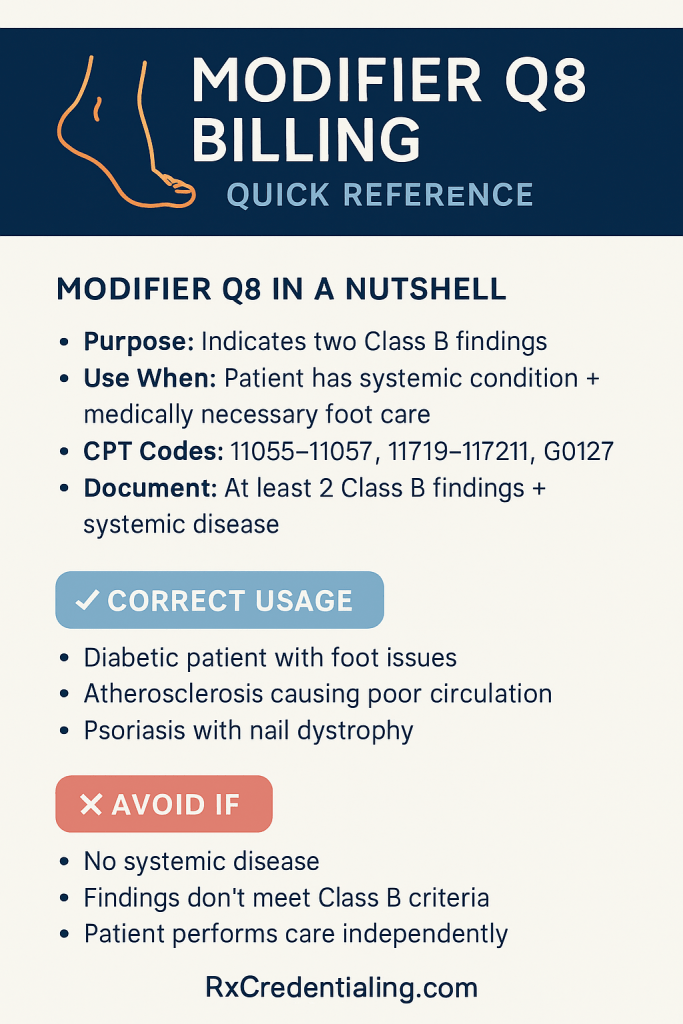
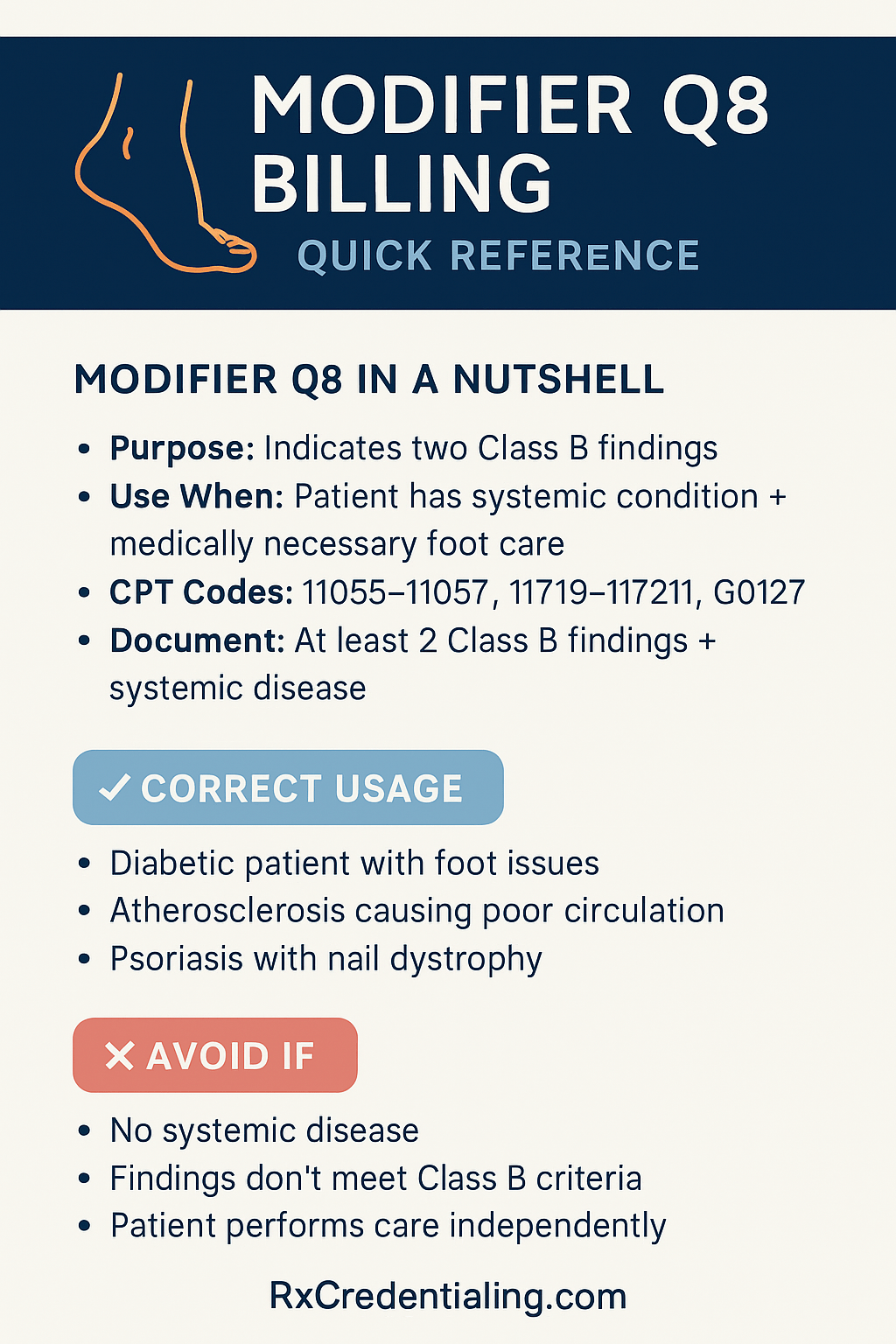
Modifier Q8 is a HCPCS Level II modifier created by the Centers for Medicare & Medicaid Services (CMS). It indicates the presence of two Class B findings in a patient with a systemic condition such as diabetes or atherosclerosis.
This modifier is essential when routine foot care becomes medically necessary, such as preventing infection or injury in vulnerable patients.
✅ Looking for expert help with insurance billing? Check out our Podiatry Medical Billing Services for streamlined support.
What Are Class B Findings?
To use Modifier Q8 properly, you must document at least two of the following findings:
- Absence of posterior tibial pulse
- Absence of dorsalis pedis pulse
- Three or more trophic changes, such as:
- Nail thickening
- Skin texture changes (e.g., thin, shiny)
- Skin discoloration
- Redness (rubor)
- Decreased hair growth
These signs indicate impaired circulation or skin integrity—making routine care medically necessary.
When to Use Modifier Q8
1. Nail Trimming for Diabetic Patient with Class B Findings
A 34-year-old man with Type 2 diabetes reports numbness and tingling in his left foot. Upon exam, the podiatrist notes:
Absent dorsalis pedis pulse
Trophic changes: hair loss, red skin, and thin texture
CPT Code: 11719
Appended Modifier: Q8
➡️ Routine trimming becomes medically necessary, and Q8 ensures claim approval.
2. Corn Removal for a Patient with Atherosclerosis
A 47-year-old man with a systemic condition (atherosclerosis) presents with a painful corn.
Findings:
- No dorsalis pedis pulse
- Trophic signs: discoloration, redness, and thin skin
CPT Code: 11055
Appended Modifier: Q8
➡️ Documenting Class B findings justifies this care under Medicare.
3. Nail Debridement in Nail Psoriasis Case
A 19-year-old with psoriasis-related nail disease comes in for pain relief.
Findings:
- Discoloration
- Thin, fragile skin
CPT Code: 11720
Appended Modifier: Q8
➡️ Even younger patients with systemic conditions qualify when signs are documented.
Accurate vs. Inaccurate Use of Q8
✅ Accurate Use
Use Modifier Q8 only if:
- The patient has a qualifying systemic condition
- At least two Class B findings are documented
- The service is medically necessary, not routine maintenance
➡️ Medicare outlines covered conditions in its Benefit Policy Manual.
❌ Inaccurate Use
Don’t use Modifier Q8 if:
- No systemic condition is present
- There’s only one Class B finding
- The patient trims nails or removes corns themselves
- Class A or C findings are incorrectly substituted
Need help staying compliant? Learn about our Insurance Credentialing Services to avoid audit risks.
Essential Billing Tips for Modifier Q8
Here’s how to ensure success when using this modifier:
- Append Q8 directly to CPT codes like 11055–11057, 11719–11721, and G0127
- Document the systemic condition and two Class B findings in the medical record
- Avoid Q8 if the patient doesn’t meet these requirements
🛠️ Learn how we assist small practices with Medical Billing Services for Small Practices.
Conclusion & Resources
Billing for routine foot care doesn’t have to be a guessing game. Using Modifier Q8 correctly allows you to get reimbursed for services that are clinically necessary.
Podiatrists and billing teams often confuse Q8 with Q7 or Q9—leading to denied claims.
Avoid this with proper documentation and smart billing practices.
📚 Recommended Reads:
- Frequently Asked Questions on Physician Credentialing
- Hiring an Insurance Credentialing Service
- Medical Billing for Physical Therapy