Shoulder arthroplasty is a complex procedure—and when it comes to coding it accurately, CPT Code 23472 is at the center of correct reimbursement and reduced claim denials.
For orthopedic surgeons, billing teams, and private practices, mastering the nuances of CPT 23472 can significantly streamline revenue cycles and ensure compliance.
In this comprehensive guide, we break down everything you need to know about billing CPT Code 23472, including documentation tips, common coding pitfalls, and best practices for clean claim submission.
What is CPT Code 23472?
CPT 23472 refers to:
“Arthroplasty, glenohumeral joint; total shoulder (glenoid and proximal humeral replacement (eg, total shoulder))”
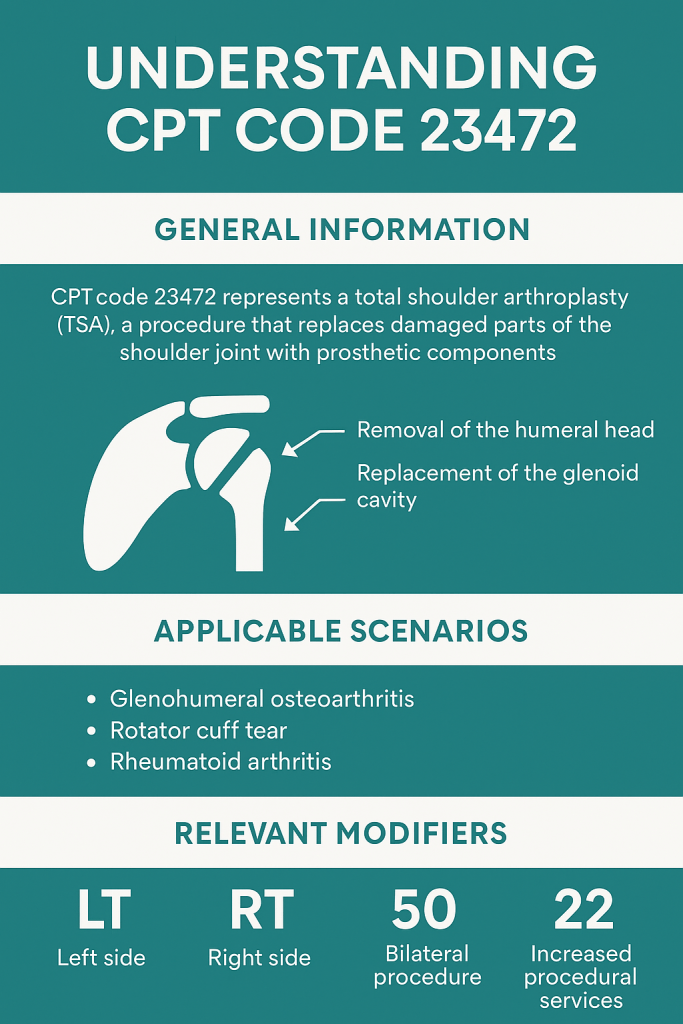
This code is used when both the humeral head and glenoid cavity are replaced during a total shoulder arthroplasty.
It is essential to differentiate this from other shoulder procedures (like hemiarthroplasty or reverse total shoulder replacements), as incorrect coding can lead to reimbursement delays.
Key Documentation Requirements
To avoid payer denials, ensure your documentation includes:
-
- Pre-operative diagnosis and clinical indications (e.g., osteoarthritis, rotator cuff tear arthropathy)
-
- Operative report clearly describing replacement of both glenoid and humeral components
-
- Laterality (right or left shoulder)
-
- Implant type and manufacturer (some payers request this)
-
- Use of imaging guidance or intraoperative navigation, if applicable
For private practices, robust insurance eligibility verification is crucial to confirm procedure coverage ahead of time. Learn more about verification services.
Billing Tips for CPT 23472
-
- Avoid Unbundling Errors
Do not report codes for individual components of the procedure separately. CPT 23472 is inclusive of the total joint replacement.
- Avoid Unbundling Errors
-
- Use Modifiers Wisely
-
- Modifier -RT or -LT for laterality
-
- Modifier -22 for increased procedural services (must be justified in detail)
-
- Modifier -58, -78, or -79 may be used for staged or related procedures in the global period
-
- Use Modifiers Wisely
-
- Global Period
CPT 23472 has a 90-day global period. Ensure your follow-up visits and post-op care are coded correctly to avoid bundling issues.
- Global Period
- Pre-authorization
Many commercial insurers require prior authorization for shoulder arthroplasty procedures. This is especially vital for those utilizing Virtual Medical Assistants for administrative support.
Common Coding Mistakes to Avoid
-
- Using the wrong CPT code for partial or reverse shoulder replacements
-
- Failing to document medical necessity
-
- Missing lateral side documentation, which leads to denials
- Incorrectly billing bilateral procedures—these must be supported by proper modifier use and documentation.
Credentialing for Orthopedic Surgeons
Credentialing delays can slow down billing, especially for high-cost procedures like shoulder arthroplasty. Whether you’re a solo provider or part of a multi-specialty group, getting credentialed with all major payers is essential. Our Insurance Credentialing Services help streamline this process.
If you’re expanding into telehealth or remote consults for orthopedic evaluations, Telehealth Credentialing can also be adapted for your specialty.
Optimize Reimbursement with Specialist Billing Support
For those offering orthopedic services, working with a billing partner that understands surgical nuances can increase your revenue and reduce administrative burden. While RxCredentialing specializes in multiple disciplines—from Cardiology Billing to OB-GYN Billing—our expertise also includes complex procedural codes like 23472.
Orthopedic billing can mirror the same challenges as Physical Therapy Billing or Radiology Billing, particularly in coding accuracy, modifier usage, and documentation integrity.
Stay Ahead with Compliance & Coding Updates
Always stay informed about CPT updates via resources such as the American Academy of Orthopaedic Surgeons (AAOS), which provides coding and reimbursement guidance for orthopedic procedures.
Additionally, reading industry-specific resources like our Easy Guide to Modifier Q8 or CPT 97602 Wound Care Billing posts can keep your team sharp.
Final Thoughts
CPT Code 23472 is a high-value billing opportunity—but only when done right. From clear documentation to payer-specific rules and proper modifier usage, every detail counts. If you’re overwhelmed with coding or struggling with revenue loss, partnering with experts in physician billing can be the difference between denied claims and maximized revenue.