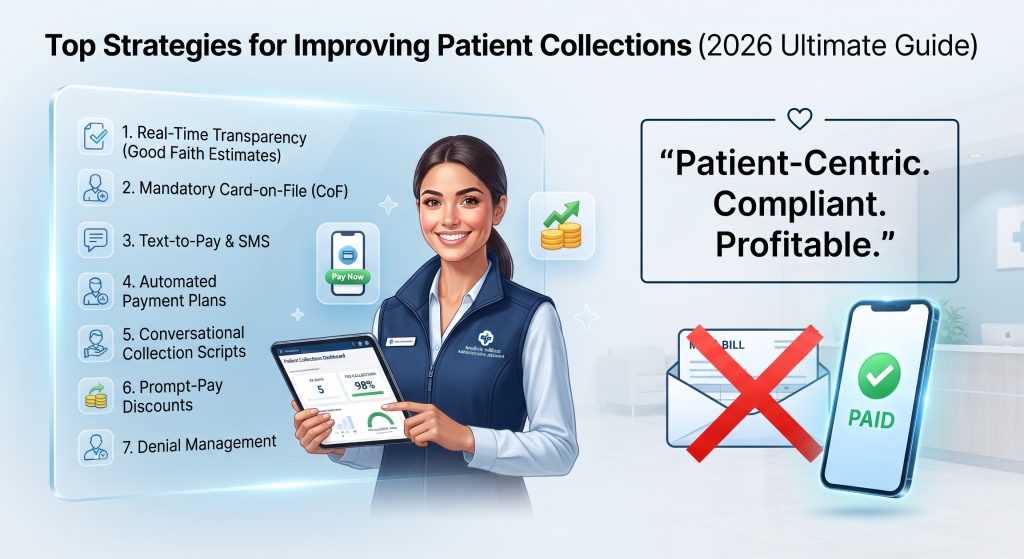
Patient collections have shifted from a back-office chore to a front-line revenue requirement in today’s high-deductible era. By implementing upfront financial transparency, mandatory card-on-file policies, and digital text-to-pay options, medical practices can drastically curtail revenue leakage and achieve up to 98% collection rates.
Frequently Asked Questions
Is it legal to keep a credit card on file for medical bills?
Yes, it is perfectly legal and increasingly the standard in 2026. You must use a PCI-compliant gateway (like Stripe or Authorize.net) and have the patient sign an authorization form that clearly outlines the charge limits.
How much revenue do practices lose to patient non-payment?
Industry benchmarks from MGMA suggest small practices lose 10% to 18% of their total potential revenue to uncollected patient responsibility.
What is a ‘Good Faith Estimate’?
Under the No Surprises Act, it is a document provided to uninsured or self-pay patients that outlines the expected charges for a scheduled service. In 2026, many practices provide this to everyone to help set payment expectations early.
Why is ‘Time of Service’ (TOS) collection so important?
Once a patient leaves your facility, the likelihood of collecting their balance drops by nearly 20% every 30 days. Collecting at TOS is the only way to ensure 95%+ collection rates.
Should I outsource my patient collections?
If your staff spends more than 5 hours a week mailing statements and making calls, it is more cost-effective to use medical billing services for small practices that handle this as part of the RCM cycle.
Revenue Leakage
The amount of total practice revenue often lost to unworked patient balances in small practices.
Deductible Burden
Nearly 33% of medical costs are now the patient’s direct responsibility due to high-deductible plans.
Success Rate
Collection probability when payment is secured at the point of service (POS).
The Deep Dive: The Shift to Patient-Centric RCM
The traditional model of “treat now, bill later” is functionally obsolete. In 2026, healthcare providers must adopt a retail-style mindset. Patients are consumers; they expect transparency, digital convenience, and flexible payment options. By connecting insurance eligibility verification directly to the front-desk workflow, you eliminate the “sticker shock” that leads to bad debt.
According to the HFMA, the cost of sending three paper statements can exceed the value of a small co-pay. Shifting to digital-first communication is not just about convenience—it is about protecting your bottom line.
7 Strategies for Mastery in 2026
Real-Time Financial Transparency
Don’t let the first time a patient hears about their $200 deductible be via a surprise bill in the mail. Use automated tools to provide a “Good Faith Estimate” 48 hours before the visit. This builds trust and allows the patient to budget for the care, which is a core pillar of best practices for modern care.
Mandatory Card-on-File (CoF) Implementation
Securely vaulting a credit card at check-in is the single most effective way to eliminate aging patient AR. By using PCI-compliant tokens, you can automatically charge balances up to a pre-authorized limit (e.g., $150) the moment the EOB is processed.
| Metric | Traditional Billing | Modern CoF System |
|---|---|---|
| Days in A/R | 45 – 60 Days | 3 – 7 Days |
| Administrative Cost | $15 – $25 per bill | $0.50 per charge |
| Collection Rate | 60% Average | 98% Average |
Text-to-Pay & SMS Links
In 2026, 70% of patients prefer to settle medical bills on their smartphones. If you send a paper bill, it goes in a stack. If you send a text with a “Click to Pay” link, the transaction usually happens within 14 minutes. This technology is vital for quick AR recovery.
Automated Payment Plans
For high-cost procedures like orthopedics or neurology, offer monthly installments. Automated recurring billing ensures you collect the full amount over 3–6 months without manual staff follow-up.
Free Credentialing With Medical Billing From $499 / month
Join the fastest growing network of healthcare providers who have streamlined their medical billing operations and eliminated administrative headaches.
Conversational Collection Scripts
Training your front-desk team is just as important as technology. Replace “Would you like to pay?” with “Your estimated portion for today is $45. Would you like to use the card we have on file or a different one?” Assume the payment to increase check-in collections by 25%.
Incentivized Prompt-Pay Discounts
For self-pay patients or those with massive deductibles, offer a 5-10% “Prompt Pay Discount” if settled within 48 hours. This reduces the administrative load of chasing the full amount and improves your physician billing efficiency.
Specialized Denial Management
Sometimes patient collections fail because the insurance was billed incorrectly. Using professional healthcare denial management services ensures the claim is processed correctly first, so the patient balance reflects the true amount owed.
About the Author: Adam Blake
Adam is a Senior Revenue Cycle Strategist at Rx Credentialing with over 15 years of experience in helping private practices optimize their clinical workflows and financial health. He is a frequent contributor to medical practice management journals and an expert in 2026 healthcare billing technology.