Timely Filing Limit for Claims in Medical Billing 2026

Discussed Points

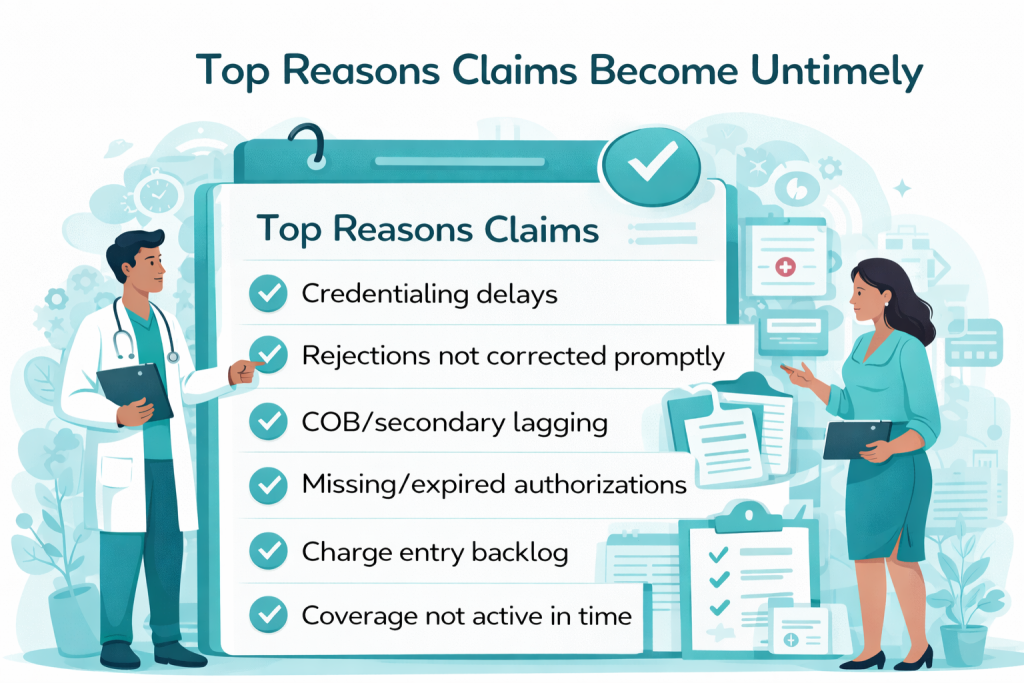
Why claims become untimely

Timely filing limit (TFL) for insurance claims: what it means in medical billing

A timely filing limit (often shortened to TFL) is the maximum time a payer allows you to submit a claim after the date of service (DOS) or discharge date (depending on claim type). If a claim arrives after that deadline, many payers deny it as “untimely filing”—even if the service was medically necessary and correctly coded.

Key takeaway: TFL is not a “suggestion.” It’s a strict payment rule that can permanently block reimbursement unless you qualify for a documented exception.

Terms you’ll see in payer portals and EOB/ERA: timely filing, timely submission, filing deadline, proof of timely filing, corrected claim filing window, and appeal timeframe.

TFL answers: “How long do we have to submit?”

  • Usually counted from DOS (professional) or discharge (facility)
  • Can vary by payer, plan type, network status, and state
  • May differ for paper vs electronic submission

Appeal deadline answers: “How long to dispute a denial?”

  • Separate clock from TFL (often 30–180 days depending on payer)
  • May require specific forms and documentation
  • Missing appeal timelines can lock the denial in place

Image suggestion: A simple timeline graphic showing “DOS → claim submission window → denial/appeal window.” (Place under this section.)

Why timely filing limits matter (especially for small practices)

Timely filing is one of the fastest ways a payer can deny a claim without reviewing the clinical details. For a small practice, that can mean lost revenue, extra admin work, and cash-flow instability. Unlike many denials, “untimely filing” is often harder to overturn unless you have strong evidence.

What late claims do to your revenue cycle

  • Turns billable visits into write-offs
  • Inflates AR aging and hides real performance issues
  • Creates rework: rebilling, documentation hunting, and appeals
  • Triggers patient balance confusion and reputational damage

Why small practices miss deadlines

  • Credentialing delays (payer not active yet)
  • Eligibility or authorization issues discovered late
  • Charge entry backlog / incomplete documentation
  • Clearinghouse rejections not corrected promptly

Small practice rule: Treat TFL like payroll—build a weekly routine that prevents anything from aging into “urgent.”

If credentialing is causing delayed first claims, fix that first. Helpful resources: insurance credentialing services, CMS-855I enrollment guide, and CMS-588 EFT setup.

Image suggestion: “Top 6 causes of untimely filing” checklist-style visual. (Place at the end of this section.)

How to find a payer’s timely filing limit (the reliable way)

Timely filing limits change, and many “tables online” go stale. The best approach is to keep a living “payer rules” sheet that your team updates from official sources: provider manuals, payer portals, contract language, and remittance messages.

Where to look (in order)

  • Provider manual (Claims Submission / Timely Filing section)
  • Payer portal (Claim filing guidelines / policies)
  • Your contract (network-specific rules)
  • ERA/EOB remarks (may reference filing limits and “proof” requirements)

What to record in your internal sheet

  • Initial claim limit (DOS vs discharge)
  • Corrected/adjusted claim limit
  • Appeal deadline and where to submit
  • Secondary claim/COB deadline
  • Proof of timely filing rules (screenshots, clearinghouse reports, etc.)

Best practice: save a PDF/screenshot of the payer page (or manual section) showing TFL and the date you captured it. That becomes your evidence if the payer disputes your timeline later.

External references that explain general SNF/claim coverage concepts and payer guidance frameworks: Medicare.gov and CMS.gov. (Always verify deadlines in the payer’s official provider materials.)

Image suggestion: Screenshot-style mockup: “Where to find TFL inside a payer provider manual.” (Place under this section.)

Common timely filing windows (what most practices see)

Filing limits vary widely across payers and plans. Many commercial plans fall into 90–180 days, while some government programs and certain plans allow longer. Treat the table below as a starting point—then confirm the exact rule in payer materials for your contract and state.

Payer category Typical initial claim window Notes that change the answer
Medicare (Original) Often up to 12 months from DOS (varies by claim type) Facility vs professional, special situations, and documentation rules can apply
Medicaid Often 90 days to 12 months (state-specific) State Medicaid policies and MCO rules vary significantly
Commercial (in-network) Commonly 90–180 days Employer group plans and state rules can extend/shorten limits
Commercial (out-of-network) Sometimes 180 days+ but not guaranteed OON rules depend heavily on plan documents and claim submission method
Medicare Advantage Often 90–365 days (plan-specific) Prior authorization and network policies may drive denials earlier than TFL
Tricare / Military plans Often up to 12 months (plan rules apply) Claim type and coordination rules can change the window

Image suggestion: “TFL by payer type” bar chart or infographic (90 / 120 / 180 / 365 days). (Place after table.)

Corrected claims, secondary claims, and appeals: the deadlines most offices miss

Even practices that submit initial claims on time can lose money by missing the separate clocks for corrected claims, coordination of benefits (COB)/secondary billing, and appeals. These are not optional timelines—payers enforce them aggressively.

Corrected / adjusted claims

  • Used when you need to fix data (DX, modifiers, NPI, place of service, etc.)
  • Many payers require a “corrected claim” indicator and original claim number
  • Deadline may be shorter than initial filing

Secondary claims / COB

  • Often counted from the primary payer’s EOB/ERA date (not DOS)
  • Missing COB windows can strand patient balances
  • Keep primary EOBs attached when required

Appeals (when the claim is denied)

Appeals have their own deadlines and submission channels (portal upload, fax, mailing address, or specific forms). Track these like a legal calendar: denial date → appeal due date → next action.

  • Save proof: screenshots, confirmation pages, certified mail receipts
  • Send the minimum required documentation (not everything)
  • Write a structured appeal letter: issue → policy reference → your evidence → request

Revenue protection move: For every payer, record 4 dates in your “payer rules” sheet: initial claim, corrected claim, appeal, and secondary/COB.

Image suggestion: Flow diagram: “Initial claim → rejection → corrected claim → denial → appeal → resolution.” (Place under this section.)

A simple timely-filing workflow for small practices (weekly routine that prevents late claims)

The easiest way to avoid timely filing denials is to run a predictable weekly cadence. You don’t need a huge billing department—just a repeatable system. Here’s a workflow that works well for solo and small group practices.

Daily (10–20 minutes)

  • Clear clearinghouse rejections within 24–48 hours
  • Confirm eligibility/authorization flags before re-submitting
  • Post ERAs that arrived today (even partial posting helps)

Weekly (60–90 minutes)

  • Run “unbilled encounters” report and submit everything ready
  • Work 30–45 day AR follow-ups first (avoid aging into panic)
  • Update your “payer rules” sheet if you see new payer messages

Monthly (owner-level review)

Metric What it tells you Target (small practice)
Clean claim rate How many claims are accepted by payers/clearinghouse without edits 95%+
Denial rate How many claims come back denied (not rejected) < 8%
Days in AR How quickly you convert services into cash 30–40 days (specialty-dependent)
Timely filing denials Whether your workflow is failing at the calendar level Near zero

If your monthly billing costs are unclear, use this guide to benchmark: How much do medical billing services cost?

Image suggestion: “Weekly billing calendar” graphic (Mon–Fri tasks). (Place after this section.)

Timely filing denials: how they happen and how to prevent them (real-world fixes)

Most timely filing denials don’t happen because a practice “forgot to bill.” They happen because the claim got stuck: rejections weren’t fixed, credentialing wasn’t active, payer ID was wrong, authorization was missing, or the claim sat in a “pending” status with no follow-up.

The 8 most common causes

  • Clearinghouse rejection not corrected in time
  • Member ID or payer ID mismatch
  • Provider not credentialed / effective date not active
  • Missing/expired authorization (esp. PT/OT/ST & behavioral health)
  • Coordination of benefits not updated
  • Incorrect claim type (facility vs professional)
  • Claim held for documentation but never responded
  • Staff turnover / no ownership of follow-ups

Prevention playbook

  • Set internal “submit by” targets: DOS + 7 days (ideal) and DOS + 14 days (latest)
  • Work rejections daily (don’t wait for month-end)
  • Track payer follow-up touchpoints: date, rep, ref #, outcome
  • Keep a “short deadlines first” queue (90-day payers get priority)

Owner-level safeguard: Ask your biller for a monthly list of claims approaching the filing deadline (e.g., “claims older than 45 days not submitted” and “claims older than 60 days unpaid”).

If you’re seeing repeated payer enrollment issues that delay claim submission, start here: Credentialing FAQs and Credentialing & enrollment services.

Image suggestion: “Timely filing denial prevention checklist” (printable-style). (Place at end of this section.)

Need a billing team that actually does payer follow-ups?

Timely filing success depends on follow-ups, not just “claim submission.” If your practice is dealing with aging AR, denials, or payer enrollment delays, we can help you set up a clean workflow and reduce preventable write-offs.

Image suggestion: Small “dashboard” screenshot mock (AR aging bars + clean claim rate). (Place under CTA in your page builder.)

Timely filing limit FAQ (quick answers)

What is a timely filing limit in medical billing?

A timely filing limit is a payer’s deadline for when a claim must be received after the date of service (or discharge date for some facility claims). Claims received after the deadline are commonly denied as untimely.

Are timely filing limits the same for every insurance company?

No. Timely filing limits vary by payer, plan type, network status, and sometimes by state. Always confirm using the payer’s provider manual or portal guidance for your specific contract.

Is the appeal deadline the same as the timely filing limit?

Usually not. Appeals have their own deadlines and submission requirements. A practice can submit an initial claim on time but still miss an appeal window if denials aren’t worked quickly.

What counts as “proof of timely filing”?

It depends on the payer. Common proof includes clearinghouse acceptance reports, transmission confirmations, portal submission screenshots, and certified mail receipts for paper claims.

Do corrected claims have a different deadline?

Often yes. Many payers set a separate timeframe for corrected/adjusted claims, and they may require a corrected claim indicator and the original claim number.

External references: use payer/provider manuals and official payer portals whenever possible; Medicare and CMS resources can provide general direction: Medicare.gov and CMS.gov.

Facebook
Twitter
LinkedIn
 

Insurance Credentialing

$ 140 / Application
  • CAQH registration
  • NPI registration
  • Credentialing & Enrollments
  • Contracting & Negotiations
  • Direct deposit setup
  • Web Portal Setup for Eligibility & Claim Status Check
 

Practice Set-Up

$ 499 One Time
  • Company Formation
  • EIN Registration
  • Malpractice Insurance
  • Administrative Consultation
  • State Fee will be upon you
  • Practice Set-up Assistance
  • General Liability Insurance Assistance
  • Virtual office Space Assistance

Front Desk Assistance

$ 1599 /Month
  • Day to day practice administration
  • Appointment Scheduling
  • Eligibility and benefits check
  • Copay collection
  • Referral Coordination
  • Scheduling follow ups
  • Assist in telehealth visits

Medical Billing

$ 3%-5% / Collection
  • Demographic entry
  • Eligibility check
  • Benefits check
  • Authorization check
  • Charge entry
  • Claim submission
  • Payment posting
  • Denial management
  • Accounts receivable reporting

Fill the below form along with details of your question. We will get back to you at earliest.


Contact us