A Strategic Ranking for Private Practice Growth | Written by Adam Blake
The Quick Verdict
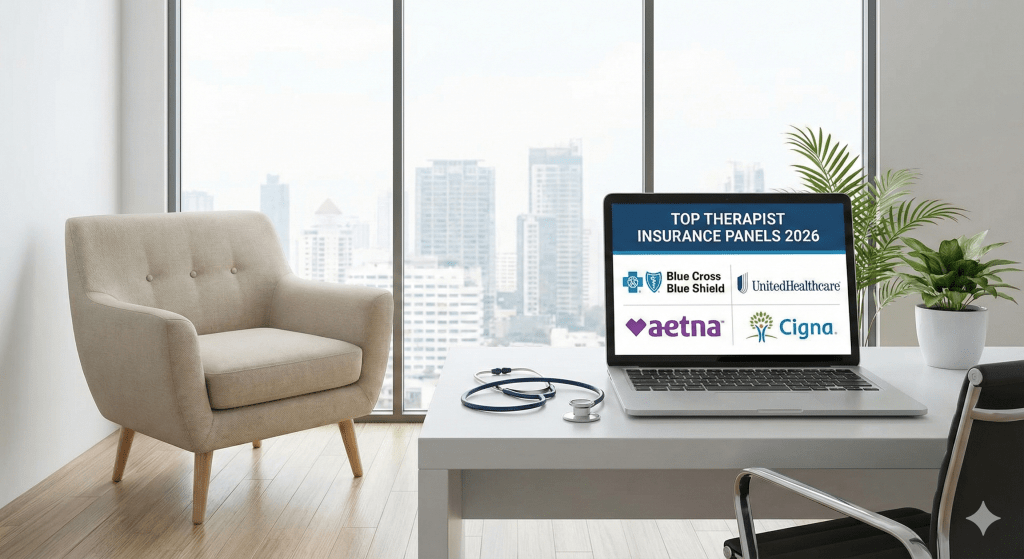
For most private practice therapists, Blue Cross Blue Shield (BCBS) offers the best balance of high reimbursement rates and patient volume. UnitedHealthcare (Optum) is essential for volume, and Aetna is the leader in telehealth support.
The “Cash-Pay vs. Insurance” debate is evolving. In 2026, high deductibles and the rise of “Aggregators” (like Headway and Alma) have changed the landscape. Getting credentialed is no longer just about filling a slot; it’s about building a sustainable revenue cycle.
However, credentialing is an investment. Some panels pay $130+ per session, while others struggle to reimburse $60. Below is our “Payer Intelligence” guide, diving deep into the pros, cons, and hidden details of the top panels.
The “Big 5” Payer Intelligence Guide
We analyzed data from hundreds of credentialing applications to rank these payers based on Rate, Speed, and Administrative Ease.
Blue Cross (BCBS)
#1 For Rates- Pros: Highest reimbursement rates (avg $110-$160). Massive patient loyalty. The “BlueCard” program allows you to see out-of-state patients easily.
- Cons: Credentialing is slow (90-120 days). Strict audit clawback policies.
- Best For: Established practices wanting to maximize revenue per session.
UnitedHealthcare
#1 For Volume- Pros: Largest insurer in the US. “Provider Express” portal is user-friendly. Fast claims processing (often 10 days).
- Cons: Rates are slightly lower than BCBS. Customer service for providers can be difficult to reach.
- Best For: New practices needing to fill a caseload quickly.
Aetna
Telehealth- Pros: Aggressive support for Telemental Health. Very stable platform (Availity/NaviNet). Rates are competitive in urban areas.
- Cons: Can be “panel closed” in saturated cities. Negotiating rates is difficult for solo practitioners.
- Best For: Remote-first or hybrid therapy practices.
Medicare
Stability- Pros: Recession-proof. Guaranteed payment within 14 days. No “negotiation” needed (rates are set by Congress).
- Cons: Requires strict compliance (PECOS). Specific licensure required (LCSW/PhD; LMHCs now eligible in 2026 but rules vary).
- Best For: Serving the aging population and ensuring steady cash flow.
Reimbursement Rate Comparison (2026 Est.)
Rates vary by state, license type, and rural/urban designation. This table provides a strategic hierarchy.
| Payer | Est. Rate (90837) | Admin Difficulty | Telehealth Friendly? |
|---|---|---|---|
| BCBS | $110 – $160 | Medium | Yes |
| Aetna | $95 – $135 | Low | Very High |
| UHC / Optum | $85 – $120 | Low | High |
| Cigna (Evernorth) | $80 – $115 | Medium | Yes |
| Medicaid | $60 – $90 | High | Varies by State |
Get Free Credentialing with Medical Billing
Stop losing revenue to the “Credentialing Gap.” Let us handle your entire cycle.
Crucial Insight: Direct Credentialing vs. Aggregators
In 2026, many therapists are using “Aggregators” like Headway or Alma. It is vital to understand the trade-off.
- Aggregators (Headway/Alma): They get you paneled in 2-4 weeks. However, they take a cut of your reimbursement, and you do not “own” the credentialing. If you leave them, you lose your insurance status.
- Direct Credentialing: Takes 90-120 days. However, you keep 100% of the reimbursement rate, and you own the contract. You build equity in your own practice.
Recommendation: Use an aggregator for speed if you are desperate for cash flow, but start your Direct Credentialing process immediately to secure your practice’s long-term value.
The 3-Step Credentialing Ladder
Before you apply to any panel, you must have your foundation in order. Use this checklist:
- NPI & Taxonomy: Ensure your NPI is active and your taxonomy code matches your license exactly. Get NPI Help Here.
- CAQH ProView: 90% of commercial payers use CAQH. If your profile is outdated or has gaps, your application will be ignored. See our CAQH Master Guide.
- The Application: Apply via the payer’s portal (e.g., Availity). Follow up every 14 days. This is the “black hole” phase where applications get lost.
Frequently Asked Questions
Can I negotiate my reimbursement rates?
Yes! However, you typically need to be on the panel for at least 6-12 months. You must provide data showing your value (e.g., specializations, low readmission rates, serving underserved areas).
How long does the process take?
On average: Medicare takes 30-60 days. Commercial payers (BCBS, Aetna) take 90-120 days. Medicaid can take 3-6 months depending on the state.
Do I need to be credentialed for out-of-network billing?
No, but it helps. Some payers require “Data File” entry to process out-of-network claims efficiently. Learn more in our Billing Guide.
About the Author: Adam Blake
Adam has helped hundreds of healthcare providers start, grow, and sustain medical practices with his 15 years of extensive experience in the field. He specializes in revenue cycle management, payer enrollment strategies, and practice optimization.