The “Volume Engine” of Private Practice | Written by Adam Blake
What is Medicaid Credentialing?
Medicaid credentialing is the formal process of enrolling as a provider with state-funded health programs. Unlike Medicare (which is federal), Medicaid is run by individual states. This means there are 50 different application processes, often involving a complex web of Managed Care Organizations (MCOs) that handle the actual patient care.
Many new private practice owners initially hesitate to credential with Medicaid. The common refrain is: “The reimbursement rates are too low.” While it is true that Medicaid rates typically lag behind commercial payers like BCBS or Aetna, Medicaid offers something no other payer can match: Volume.
In 2026, Medicaid rolls have expanded significantly in many states. For new practices struggling to fill their caseload, Medicaid is the fastest way to become busy. However, the enrollment process is notoriously bureaucratic, requiring site visits, strict revalidation cycles, and compliance with the 21st Century Cures Act.
If you are planning to start a new medical practice, understanding the nuances of Medicaid—specifically the difference between FFS and MCOs—is critical for your revenue cycle.
Is Medicaid Right for Your Practice?
Before diving into the paperwork, evaluate the business case for your specific specialty.
| The Pros (Why Do It) | The Cons (The Trade-Off) |
|---|---|
| Instant Volume: Medicaid panels are rarely “closed.” You will get referrals immediately. | Lower Rates: Reimbursement is often 60-70% of Medicare rates (varies by state). |
| Guaranteed Payment: State governments rarely go bankrupt; payments are consistent. | Admin Heavy: Requires strict compliance, frequent revalidation, and site visits. |
| No Marketing Cost: Patients find you via state directories; zero ad spend required. | MCO Complexity: You must credential with the state AND separate managed care plans. |
The Critical Distinction: FFS vs. MCOs
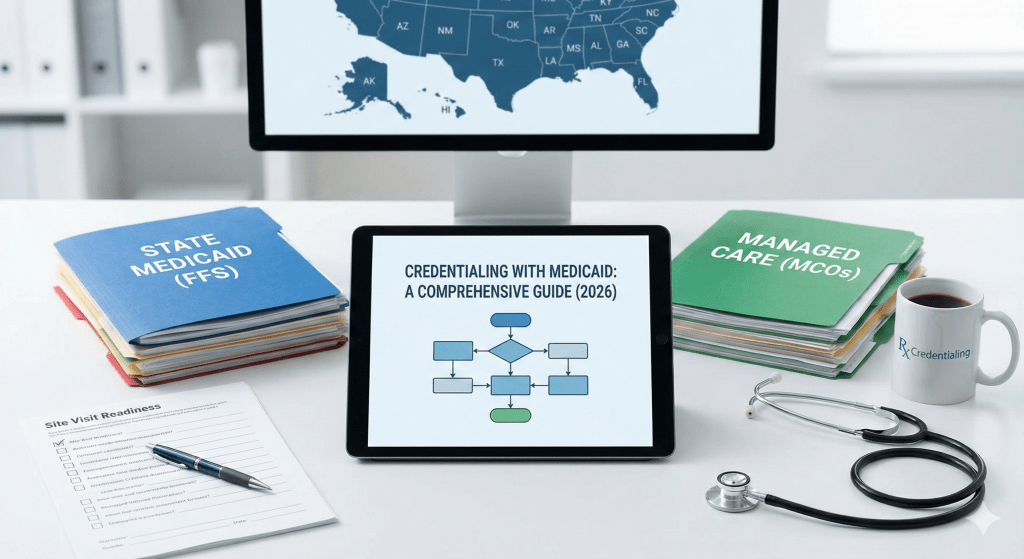
This is where 90% of providers get confused. When you say “I want to take Medicaid,” you are actually talking about two distinct layers of credentialing.
Layer 1: State Medicaid (FFS)
This is “Fee-For-Service” or straight Medicaid. You apply directly through the state’s MMIS portal (e.g., Medi-Cal in CA, NYS Medicaid in NY). This allows you to see patients who are not enrolled in a private plan. You MUST do this step first.
Layer 2: Managed Care (MCOs)
Most states have privatized their Medicaid. They pay private companies (like UnitedHealthcare Community Plan, Molina, or Centene) to manage patients. Once you are approved by the state (Layer 1), you MUST also credential with these MCOs individually to see their patients.
Critical Warning: In many states, 70-80% of beneficiaries are enrolled in MCOs. If you stop at Layer 1 (State Enrollment), you will likely be considered “Out of Network” for the vast majority of Medicaid patients walking through your door.
The Credentialing Process: Step-by-Step
While every state portal is different, the core requirements are mandated by federal law. Here is the universal workflow.
Step 1: Obtain Prerequisites
Before logging into any portal, ensure you have:
- NPI Type 1 & Type 2: See our NPI Guide if you are unsure about the difference.
- Taxonomy Codes: Ensure they match your license exactly.
- Malpractice Insurance: Medicaid typically requires $1M/$3M coverage.
- Disclosure of Ownership: You must disclose anyone with 5% or more ownership interest in your practice (to prevent fraud).
Step 2: Submit State Enrollment (The MMIS Portal)
Navigate to your state’s Medicaid Provider Portal. Complete the “Disclosure of Ownership and Control Interest Statement.” This is a federal requirement. Warning: Any discrepancy between your name on your license, your NPI record, and your bank account will cause an instant rejection.
Step 3: The Site Visit (Medicaid Specific)
Unlike Medicare which relies on automated checks, Medicaid regulations (42 CFR 455.432) classify providers by risk level. If you are “Moderate” or “High” risk, a site visit is mandatory.
- Limited Risk: Physicians, Groups (Usually no site visit).
- Moderate Risk: PT, Ambulance, Community Mental Health Centers (Site visit required).
- High Risk: New DME suppliers, Home Health Agencies (Site visit + Fingerprinting).
Step 4: MCO Contracting
Once you receive your Medicaid Provider ID from the state, you can now apply to the MCOs (Molina, Blue Cross Community, etc.). This often involves a separate CAQH application. Learn more about outsourcing this complex step.
Get Free Credentialing with Medical Billing
Stop losing revenue to the “Credentialing Gap.” Let us handle your entire cycle.
The “Audit-Proof” Documentation Checklist
Medicaid applications are legal documents. Missing a single file usually resets your application timeline.
| Document | Common Pitfalls |
|---|---|
| W-9 Form | Must be signed within the last 30 days. Address must match the practice location exactly. |
| Voided Check | Must be pre-printed with the practice name. “Starter checks” are often rejected. |
| License Copy | Must be the current, active license with no disciplinary restrictions. |
| Liability COI | The Certificate Holder usually needs to be the specific State Department of Health. |
| CLIA Waiver | Required if you perform any in-office labs, even simple urine dips. |
Top 3 Medicaid Credentialing Challenges
1. Revalidation Cycles
Medicaid requires revalidation every 5 years (federal law). Unlike commercial plans that might auto-renew, Medicaid will terminate your contract if you miss the revalidation window. See our guide on medical re-credentialing.
2. Retroactive Billing
While Medicare allows billing 30 days back, Medicaid rules vary by state. Some states allow retroactive billing back to the date of application submission; others strictly enforce the approval date. Knowing this helps you manage cash flow.
3. Behavioral Health Carve-Outs
For mental health providers, Medicaid often “carves out” behavioral health to a specific vendor (like Beacon Health Options or Magellan). This means you credential with the state, but bill a completely different entity. Review our Behavioral Health Billing Strategies for details.
Frequently Asked Questions
Can I opt out of Medicaid but take Medicare?
Yes. Enrollment in Medicare and Medicaid are separate decisions. However, if you are a Dual-Eligible provider (seeing patients with both), you generally need to be enrolled in both to bill the crossover claims correctly.
What is a Medicaid Provider ID?
This is a unique number issued by your state upon approval. It is NOT your NPI. You will need this number to bill any Medicaid claim.
Does Medicaid cover Telehealth?
Post-2020, most states have vastly expanded Medicaid telehealth coverage. However, originating site rules still apply in some regions. Check your state’s specific provider manual.
Why was my application denied?
Common reasons: Name mismatch between IRS and NPI records, failure to disclose an owner with a criminal record, or failure to respond to a site visit request within 10 days.
How much does Medicaid credentialing cost?
State application fees vary significantly. Many states charge an application fee (approx. $600-$700 in 2026) for “institutional” providers, while individual practitioners may be exempt. MCO credentialing is typically free.
Can I bill patients cash if I’m not credentialed?
In most states, strictly NO. Medicaid rules often prohibit “Balance Billing” or charging beneficiaries for covered services. If you are not credentialed, you typically must refer the patient to a credentialed provider or see them pro-bono. Charging them cash can lead to legal penalties.
About the Author: Adam Blake
Adam has helped hundreds of healthcare providers start, grow, and sustain medical practices with his 15 years of extensive experience in the field. He specializes in revenue cycle management, payer enrollment strategies, and Medicaid compliance.