
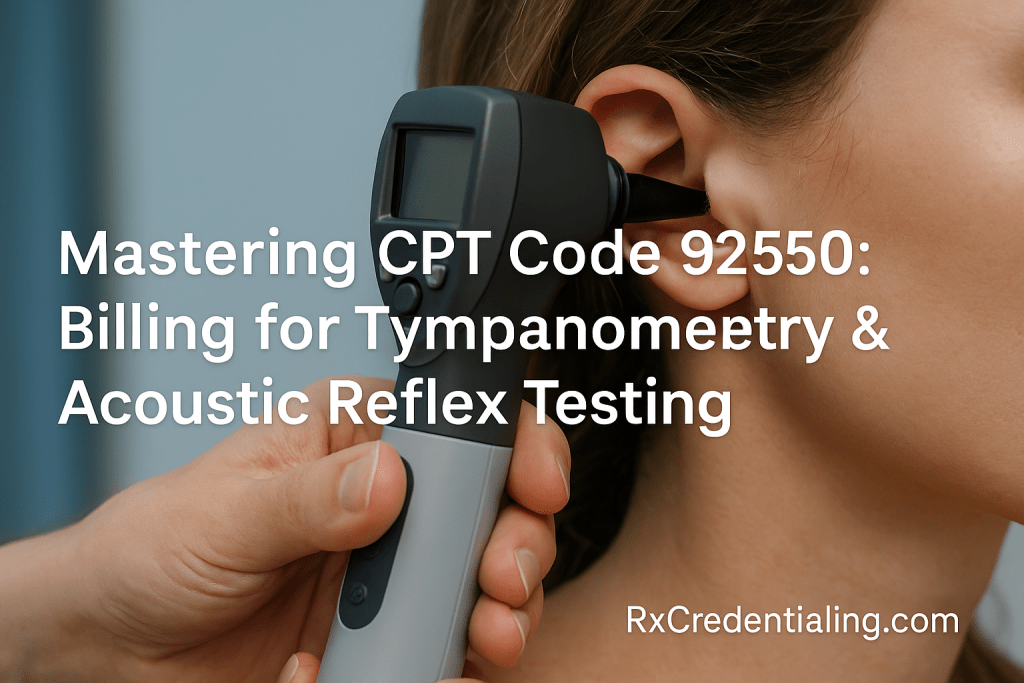
ENT medical billing requires precision, especially for bundled procedures like CPT code 92550 (tympanometry and reflex threshold measurements). Missteps can trigger claim denials, costing practices thousands annually.
This data-driven guide covers:
- ✅ CPT 92550’s clinical use cases
- ✅ Modifiers to prevent denials
- ✅ Billing scenarios with examples
- ✅ 2024 reimbursement benchmarks
- ✅ Proven appeal strategies
For credentialing support, see RxCredentialing’s ENT billing solutions.
What Is CPT Code 92550?
CPT 92550 combines two diagnostic tests:
- Tympanometry (92567)
- Measures eardrum mobility using air pressure changes
- Detects fluid, perforations, or eustachian tube dysfunction
- Acoustic Reflex Testing (92568)
- Evaluates the stapedius muscle’s response to loud sounds
- Helps diagnose nerve pathway abnormalities
Critical Rule: If both tests are performed during one visit, you must bill 92550 instead of 92567 + 92568. Unbundling is a top audit risk.
When to Use CPT 92550 (With Examples)
Case Study 1: Pediatric Otitis Media
A 6-year-old presents with:
- Ear tugging
- Fever (101°F)
- Failed hearing screening
Workflow:
- Tympanometry shows Type B flat curve (fluid present)
- Acoustic reflexes are absent at 90dB
- Diagnosis: Acute otitis media with effusion
Billing:
- ✔ 92550 (bundled test)
- ❌ 92567 + 92568 (will be denied)
Case Study 2: Eustachian Tube Dysfunction
An adult complains of:
- Ear fullness after flying
- Intermittent hearing loss
Findings:
- Tympanometry reveals negative middle ear pressure (-250 daPa)
- Reflexes present but elevated thresholds
Billing:
- ✔ 92550 + 69210 (cerumen removal, if performed)
- Modifier 59 if tests are unrelated
2024 Reimbursement Data
| Payer | 92550 Rate (National Avg.) | Key Requirements |
|---|---|---|
| Medicare | $42.18 | Medical necessity documentation |
| Aetna | $38.50 | Prior auth for patients <12 yrs |
| UnitedHealthcare | $35.75 | Modifier AB if audiologist-performed |
Denial Hotspots:
- 23% of claims rejected for missing modifiers
- 17% denied for documentation gaps
Modifier Cheat Sheet
| Modifier | When to Use | Example |
|---|---|---|
| 52 | Reduced service (one ear only) | Unilateral testing post-surgery |
| 59 | Distinct procedural service | 92550 + hearing test same day |
| AB | Audiologist-performed test | Non-MD provider |
| 76 | Repeat test by same provider | Follow-up for otitis media |
Pro Tip: Medicaid plans often require modifier TC for technical component billing.
5-Step Denial Prevention Checklist
- Verify eligibility – Confirm coverage for diagnostic audiology codes
- Attach modifiers – Use 59/AB/52 as needed
- Document medical necessity – Link symptoms to test results
- Avoid unbundling – Never split 92550 unless tests are on separate days
- Appeal within 7 days – Include:
- Tympanogram graphs
- Progress notes
- Payer policy excerpts
FAQ: CPT 92550
Q: Can I bill 92550 with 92557 (comprehensive hearing test)?
A: Yes, with modifier 59 if tests address separate diagnoses.
Q: What’s the global period for 92550?
A: Zero days – it’s diagnostic. No surgical follow-up restrictions.
Q: How often can 92550 be billed?
A: Most payers allow 2-3 tests annually without additional justification.
Key Takeaways
- 92550 replaces 92567 + 92568 when performed together
- Modifiers are revenue protectors – Use 52/59/AB strategically
- Documentation wins appeals – Save tympanograms and reflex graphs
Need expert billing support? RxCredentialing’s ENT specialists reduce denials by 63% on average.