Are you billing CPT code 95811 correctly? If you’re a primary care provider, pulmonologist, or neurologist, chances are you’re already familiar with sleep studies. But knowing the procedure isn’t enough—understanding how to accurately code and bill for polysomnography with CPAP titration is critical for ensuring timely reimbursements and avoiding costly denials.
Sleep disorders are no small issue. An estimated 50 to 70 million Americans suffer from sleep-related conditions, many of which require polysomnography for diagnosis. CPT code 95811 is the go-to code for comprehensive sleep studies involving CPAP or bi-level ventilation—but it comes with specific billing requirements.
In this blog, we’ll break down CPT 95811, when to use it, applicable modifiers, and best practices for clean claim submission.
What Is CPT Code 95811?
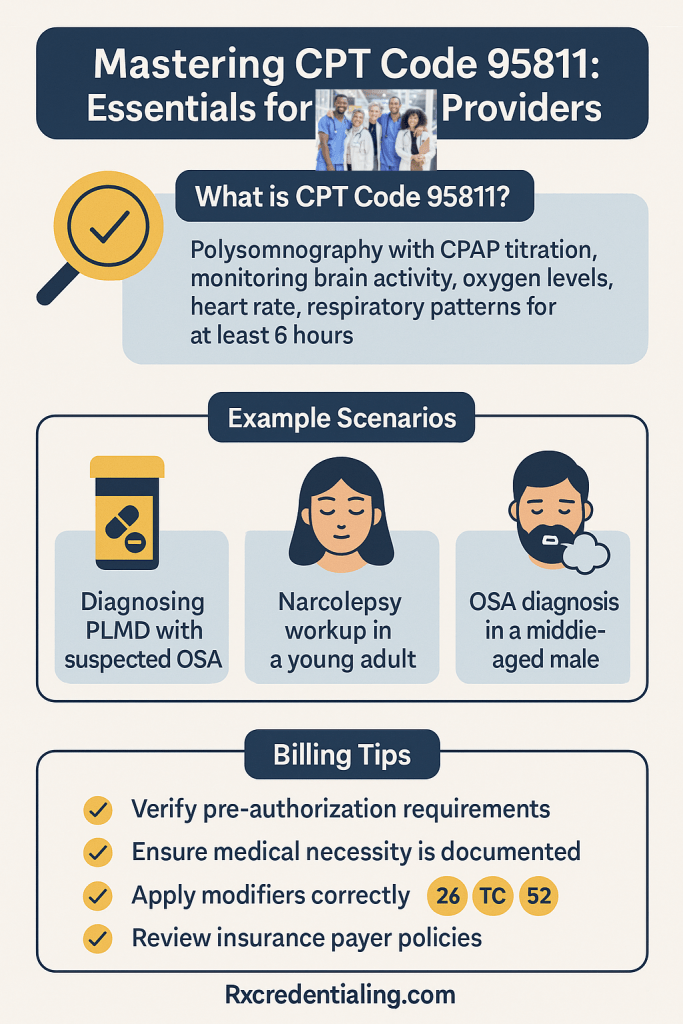
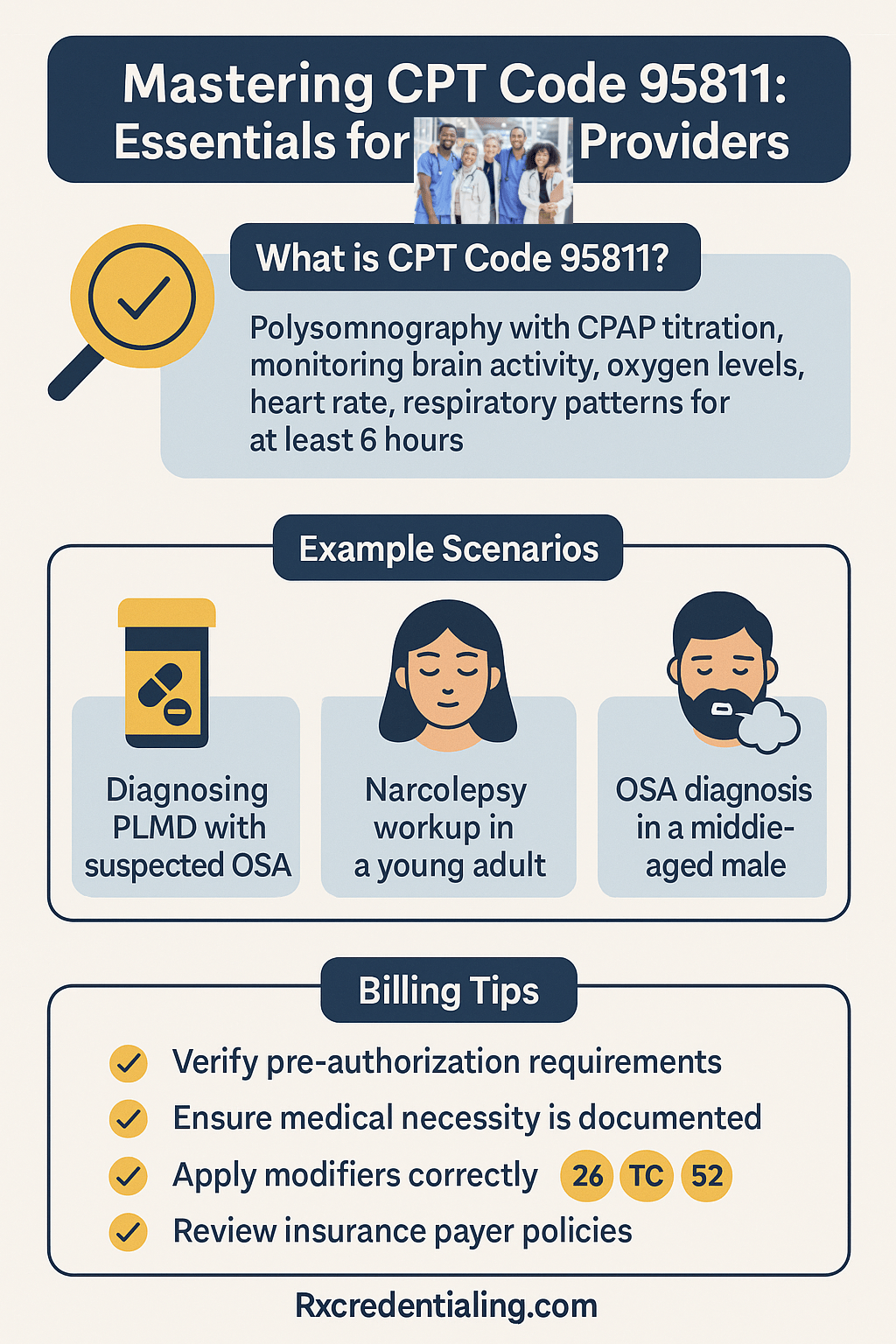
CPT code 95811 refers to polysomnography with continuous positive airway pressure (CPAP) titration. It’s performed at a sleep lab and involves monitoring a patient’s brain activity, oxygen levels, heart rate, and respiratory patterns for at least 6 hours.
This code is applicable to patients aged 6 and above, and it includes both sleep staging and ventilatory support when indicated. It’s a vital diagnostic tool for conditions like obstructive sleep apnea (OSA), narcolepsy, and periodic limb movement disorder (PLMD).
Real-World Scenarios for CPT 95811 Usage
1. Diagnosing PLMD with Suspected OSA
A 45-year-old male reports excessive daytime fatigue. A primary care provider suspects PLMD and orders a sleep study. During the test, CPAP therapy is initiated upon identifying OSA. CPT code 95811 is used to bill this procedure, as it involved both sleep monitoring and CPAP titration.
2. Narcolepsy Workup in a Young Adult
A 19-year-old female struggles with overwhelming drowsiness. The neurologist orders a polysomnography study, including CPAP titration, to rule out narcolepsy and other conditions. The 6.5-hour study justifies the use of CPT 95811.
3. OSA Diagnosis in a Middle-Aged Male
A 41-year-old man, experiencing disrupted sleep and daytime sleepiness, undergoes a sleep study. Irregular breathing patterns lead to a CPAP trial during the test. CPT 95811 is again appropriate.
Modifiers That Enhance CPT Code 95811 Accuracy
- Modifier 26: Use when billing for the professional component only (interpretation and report).
- Modifier TC: Indicates the technical component (equipment, technician, facility).
- Modifier 52: Apply if the study is less than 6 hours to indicate reduced services.
Need help understanding other billing modifiers? Check out our easy guide to Modifier Q8.
Billing and Reimbursement Guidelines for CPT 95811
To bill CPT 95811 correctly and ensure clean claims, follow these key practices:
✅ Check Pre-Authorization Requirements
Many payers require pre-authorization for sleep studies. Verify with the insurance provider to avoid claim denials.
✅ Ensure Medical Necessity is Documented
Complete documentation should include:
- Patient’s history and symptoms
- Associated risks (e.g., hypertension, cardiac concerns)
- ICD-10 codes
- CPAP titration report
- Physician’s NPI
For help streamlining documentation and insurance verification, consider our insurance eligibility verification services.
✅ Apply Modifiers Appropriately
As mentioned above, correct use of Modifiers 26, TC, and 52 can make or break a claim.
✅ Review Insurance Payer Policies
Every payer has different policies for CPT 95811. Be sure to review billing requirements before filing.
Why Outsource Your Sleep Study Billing?
Even with all this information, billing for sleep studies can be complex, especially if you’re managing multiple specialties or a growing patient load. That’s where RxCredentialing comes in.
We specialize in medical billing for small practices and offer dedicated pulmonology billing services and neurology/mental health billing support.
Need help with credentialing? Explore:
- Insurance credentialing services
- Nurse practitioner credentialing
- Virtual medical assistant services
For more information on CPT code compliance and billing, we also recommend reviewing Medicare’s guidelines on sleep study coverage (external link).