Updated for 2026 Payer Standards | Written by Adam Blake
The Executive Summary
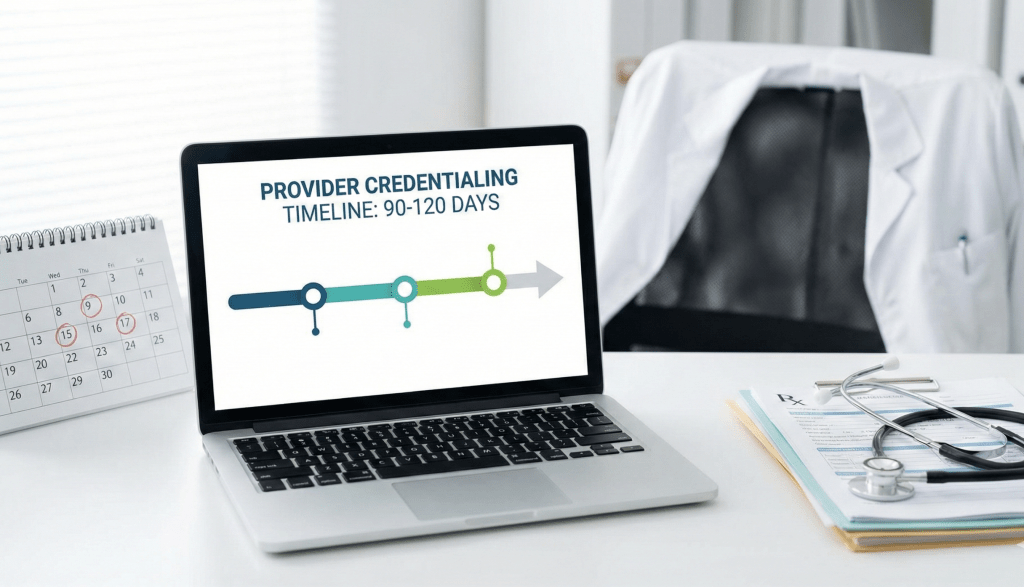
In 2026, the medical credentialing process typically takes between 90 to 120 days for commercial payers (Aetna, Cigna, BCBS) and 30 to 60 days for Medicare. However, timelines can extend up to 150 days if there are errors in the application, gaps in work history, or delays in primary source verification (PSV).
One of the most frequent and urgent questions we receive at RxCredentialing from new practices and providers is: “How soon can I start billing?”
The short answer is three to four months. The long answer is much more complicated. While digital automation in the healthcare sector has improved rapidly, payer verification processes (the human element) often remain the bottleneck. Whether you are enrolling with Medicare, Medicaid, or commercial payers like Aetna or Blue Cross Blue Shield, understanding the timeline is critical for your practice’s cash flow.
Industry statistics show that 85% of credentialing applications contain at least one error (missing date formats, incomplete work history, etc.) that triggers a manual review, adding an average of 45 days to the process.
2026 Payer Timeline Breakdown: What to Expect
Not all payers move at the same speed. Government payers have streamlined their portals (PECOS), while commercial panels often struggle with backlog.
| Payer Type | Estimated Timeline | Difficulty Level | Primary Portal |
|---|---|---|---|
| Medicare | 30 – 60 Days | Moderate | PECOS |
| Medicaid (State) | 45 – 90 Days | High (State Dependent) | State MMIS Portals |
| Commercial (BCBS, UHC) | 90 – 120 Days | High | CAQH / Availity |
| Tricare / VA | 60 – 90 Days | Moderate | Health Net / Humana |
The Credentialing Lifecycle: A 4-Phase Deep Dive
To truly understand why the process takes 90+ days, you must look at what happens behind the scenes. It isn’t just one step; it is a relay race involving multiple departments.
Phase 1: The Application Scrub (Days 1–15)
Once you submit your application, the payer’s intake team performs a “scrub.” They are checking for completeness. Statistic: Over 40% of all delays occur in this first 15-day window due to simple clerical errors like missing signature pages.
Phase 2: Primary Source Verification (Days 16–60)
This is the longest phase. The payer contracts a Credentialing Verification Organization (CVO) to verify your resume. They verify your data against NCQA standards. They check the NPDB for malpractice history. If your medical school registrar is slow to respond, your application freezes here.
Phase 3: Peer Review & Committee (Days 61–90)
Once verified, your file goes to the “Credentialing Committee.” This group typically meets only once a month. If your file is completed on the 2nd of the month, but the committee met on the 1st, you have to wait 29 days for the next meeting. This “calendar luck” is a major factor in timeline variance.
Phase 4: Loading & Contracting (Days 91–120)
Congratulations, you are credentialed! But you aren’t done. You must now review the fee schedule, sign the participation agreement, and wait for your data to be “loaded” into their claims system. If you bill before this load date, the claim will deny as “Provider Not Found.”
Get Free Credentialing with Medical Billing
Stop losing revenue to the “Credentialing Gap.” Let us handle your entire cycle.
4 Factors That Kill Your Credentialing Speed
Why does it take so long? Usually, it comes down to verification bottlenecks. Payers must verify every detail of your career history. Here is where the delays happen:
1. Incomplete Applications
If you miss a single document—like a current malpractice certificate or a peer reference—the payer puts your file at the bottom of the pile. This “kickback” adds 30+ days.
2. The “Gap” Explanation
Payers demand an explanation for any gap in work history longer than 30 days. Failure to explain a sabbatical or leave in MM/YYYY format triggers a manual review.
3. CAQH Neglect
Commercial payers pull data from your CAQH ProView profile. If you haven’t re-attested your profile in 120 days, or haven’t authorized that specific payer, they cannot process your file.
4. Primary Source Verification (PSV)
The payer must contact your medical school and residency program. If those institutions are slow to respond to verification requests, your application stalls.
The “Retroactive Billing” Myth
Many providers believe they can see patients while the application is pending and simply bill for them later once approved. This is a dangerous misconception.
- Medicare: Generally allows retroactive billing up to 30 days prior to the date your application was received. This offers some safety net.
- Commercial Payers (Aetna, UHC, Cigna): Almost never allow retroactive billing. Your “Effective Date” is usually the date the Credentialing Committee approved your file.
- Medicaid: Varies by state, but generally strict about effective dates.
💰 The Cost of Delaying
Every month a provider sits uncredentialed is lost revenue. For a standard Primary Care Physician seeing 20 patients a day, a 30-day delay equals approximately $30,000 to $45,000 in lost billable encounters.
Don’t risk your cash flow. Our team guarantees 99% first-pass accuracy to get you approved faster. For detailed costs, see our guide on credentialing costs.
Frequently Asked Questions
Can I see patients while credentialing is pending?
Technically, yes, but you cannot bill their insurance in-network. You would have to accept cash-pay or hold the claims (if the payer allows retroactive billing). Seeing patients before approval carries significant financial risk.
What is the difference between credentialing and contracting?
Credentialing validates your qualifications (Degree, License). Contracting negotiates the payment rates. You must complete credentialing before you can be contracted.
How much does RxCredentialing charge?
We offer transparent pricing for provider enrollment starting at just $499. Visit our cost breakdown page for details.
What documents do I need to start?
You need your State License, DEA Certificate, Malpractice Insurance (COI), Board Certification, Medical School Diploma, and an updated CV in MM/YYYY format. See our NPI Guide if you don’t have your NPI yet.
Why was my application rejected?
Common reasons include: Name mismatch (e.g., Maiden name vs. Married name on license), gaps in work history >6 months, expired DEA, or lack of hospital privileges (if required by specialty).
About the Author: Adam Blake
Adam has helped hundreds of healthcare providers start, grow, and sustain medical practices with his 15 years of extensive experience in the field. He specializes in revenue cycle management, payer enrollment strategies, and practice optimization.