Quick Answer
CPT code 95811 is polysomnography with continuous positive airway pressure (CPAP) titration or bi-level ventilatory assistance, performed in an attended sleep lab for patients aged 6 and older. The study must last at least 6 hours and include sleep staging plus full respiratory monitoring. Medicare reimburses approximately $500–$800 (global), $200–$350 (professional, Modifier 26), or $300–$500 (technical, Modifier TC) depending on how the service is split between the interpreting physician and the facility.
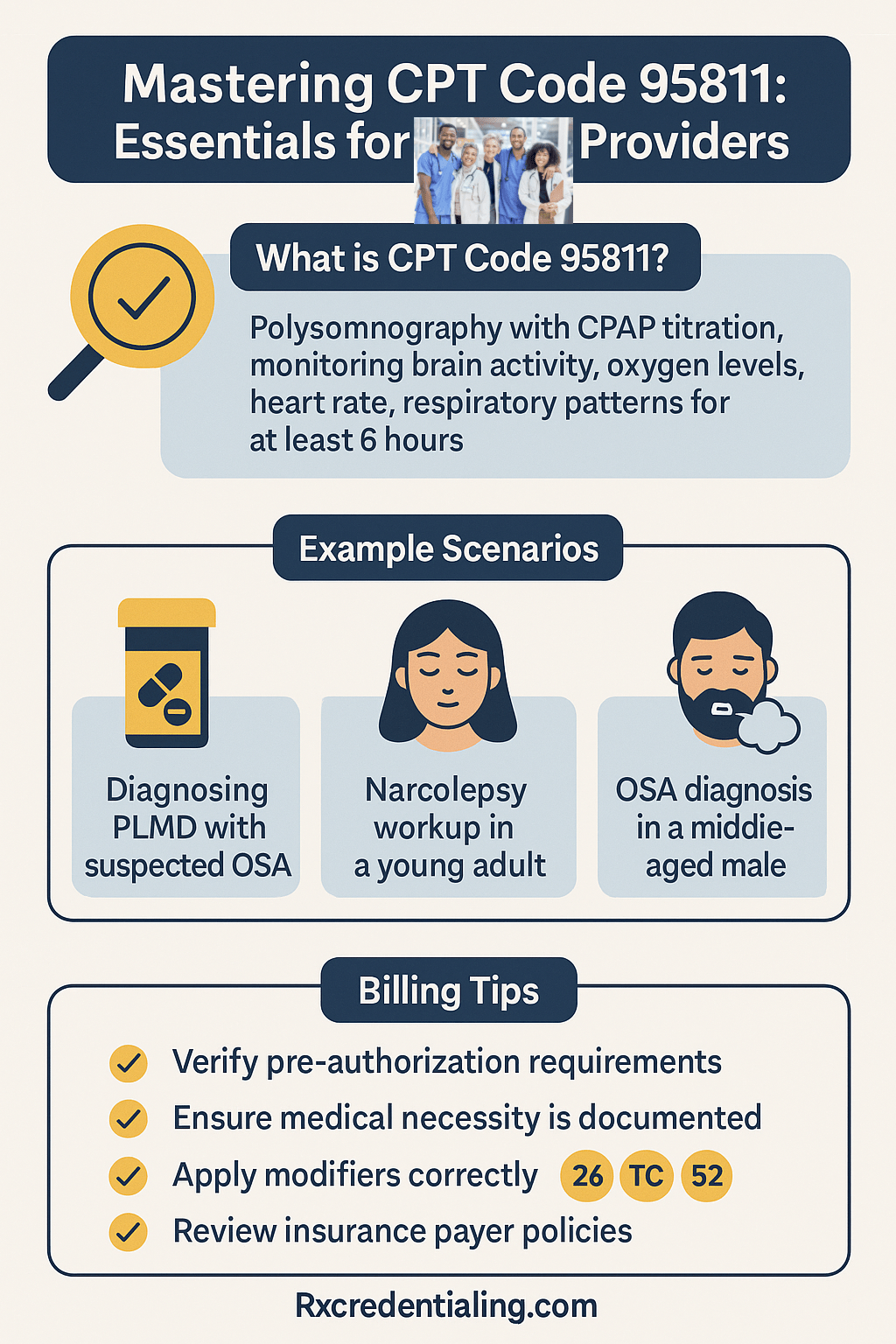
Frequently Asked Questions About CPT Code 95811
What Is CPT Code 95811?
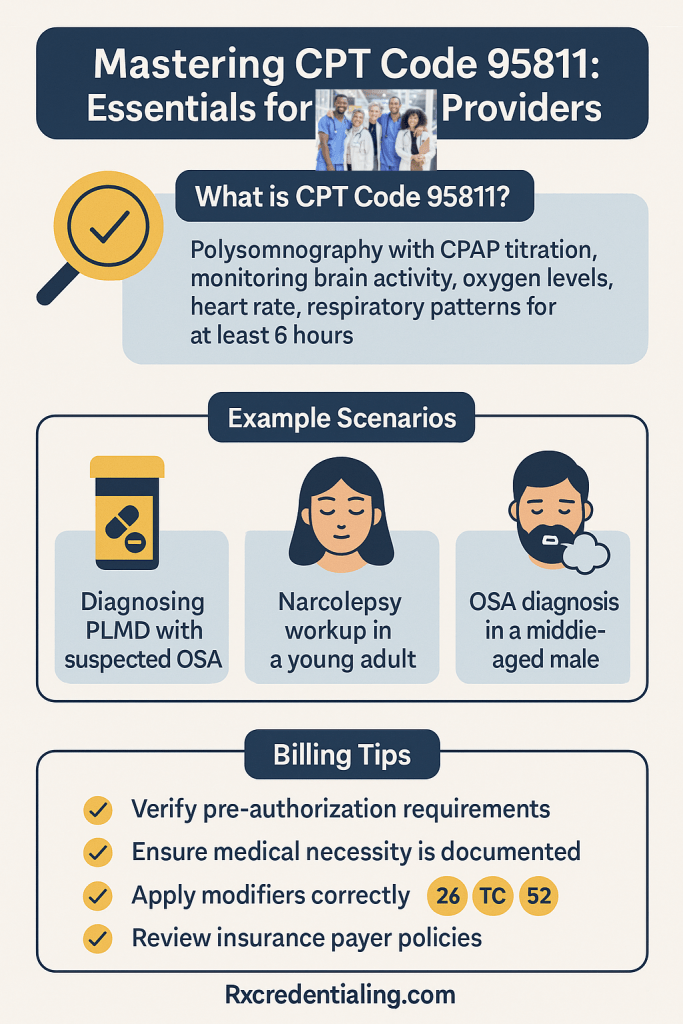
CPT code 95811 is the billing code for polysomnography with continuous positive airway pressure (CPAP) titration, performed in an attended, in-laboratory setting for patients aged 6 and older. The study monitors multiple physiological parameters simultaneously while the sleep technologist determines the patient’s optimal CPAP or bi-level pressure setting.
This code is part of the polysomnography family within the CPT coding system and is used when CPAP or bi-level ventilatory assistance is initiated during the sleep study. A purely diagnostic study without titration uses 95810 instead.
The study must last a minimum of 6 hours of recorded sleep and must be performed by a credentialed sleep technologist at an accredited sleep center. A physician or qualified healthcare provider must interpret the results and produce a signed interpretation report — without this, the claim will be denied on audit.
CPT 95811 Description: What the Code Actually Covers
The official AMA description for CPT 95811:
“Polysomnography; age 6 years or older, with initiation of continuous positive airway pressure therapy or bi-level ventilatory assistance.”
Breaking that description into its billable components:
| Component | Requirement for CPT 95811 |
|---|---|
| Patient age | 6 years or older |
| Setting | In-laboratory, attended sleep center only (not home) |
| Minimum duration | 6 hours of recorded sleep |
| Sleep staging | Required — minimum 4 channels: EEG, EOG, chin EMG, ECG/heart rate |
| Respiratory monitoring | Airflow, respiratory effort, oxygen saturation (SpO₂) |
| Leg EMG | Included — required for limb movement assessment |
| Body position | Recorded throughout study |
| CPAP/bi-level initiation | Must occur during the study — titration to therapeutic pressure documented |
| Interpretation report | Signed physician/QHP report required — must be in the medical record before billing |
CPT 95810 vs 95811: Which Code to Use?
Confusing 95810 and 95811 is the most common miscoding error in sleep medicine. Here is the definitive comparison. For a broader reference across all specialty CPT codes, see our CPT coding guide by medical specialty.
| Factor | CPT 95810 | CPT 95811 |
|---|---|---|
| CPAP titration initiated? | No | Yes — required |
| Patient age | Any age (diagnostic, no titration) | Age 6 and older |
| Study purpose | Diagnostic only | Diagnostic + therapeutic titration |
| Split-night use | First half (diagnosis portion) | Second half (titration portion) |
| Reimbursement (Medicare) | ~$400–$650 global | ~$500–$800 global |
| ICD-10 typically paired | G47.30, G47.33 (rule out) | G47.33, G47.31 (confirmed) |
| Error risk | Undercoding if CPAP was actually used | Overcoding if CPAP was not initiated |
For split-night studies: bill 95810 for the diagnostic first half and 95811 for the titration second half. Some payers require two separate claims with the same date of service; others accept both codes on a single claim line. Confirm with each payer before submitting.
CPT Code for CPAP Titration: When to Bill 95811
CPT 95811 is correct whenever CPAP or bi-level therapy is initiated during an in-lab sleep study, regardless of the original indication. These are the three most common clinical scenarios:
🛌 OSA Diagnosis — Middle-Aged Adult
A 41-year-old male with snoring and daytime fatigue undergoes overnight polysomnography. Irregular breathing triggers CPAP initiation at 2 AM. Study runs 7 hours. Bill CPT 95811 — titration was initiated.
🧠 PLMD Workup with Incidental OSA
A 45-year-old female referred for suspected periodic limb movement disorder. During the study, OSA is identified and CPAP is started. Study runs 6.5 hours. Bill CPT 95811 — the original indication doesn’t change the code when titration occurs.
😴 Narcolepsy Workup with Respiratory Findings
A 19-year-old male with excessive daytime sleepiness undergoes overnight polysomnography. Respiratory events are found and CPAP is trialed. Bill CPT 95811 — CPAP initiation triggers the more specific code regardless of the primary diagnosis.
Modifiers for CPT Code 95811
Modifier errors are the #1 reason sleep study claims are denied or recouped. Apply these correctly on every claim. For additional modifier guidance, see our Modifier Q8 billing guide for another example of specialty-specific modifier use.
Professional Component
Physician bills for interpretation and written report only. Facility bills TC separately. Use when the interpreting physician is not the facility owner.
Technical Component
Facility bills for equipment, technologist, and overhead only. Physician bills 26. Use when the facility and interpreting physician bill separately.
Reduced Services
Apply when the study lasted less than 6 hours. Document the clinical reason in the technologist’s note. Some payers deny studies under 4 hours regardless.
Distinct Service
Rarely applicable. Use only when a genuinely separate, distinct procedure was performed on the same date. Check NCCI edits before applying.
CPT 95811 Reimbursement Rates: Medicare vs. Private Payers
Reimbursement varies by payer, MAC jurisdiction, and whether you bill globally or split professional and technical components. Effective revenue cycle management includes verifying current fee schedules before claim submission — rates adjust annually with the Medicare Physician Fee Schedule update.
| Component | Modifier | Medicare (approx.) | Private Payer (typical) |
|---|---|---|---|
| Global (combined) | None | $500–$800 | $600–$1,200 |
| Professional only | 26 | $200–$350 | $250–$500 |
| Technical only | TC | $300–$500 | $350–$750 |
| Reduced (under 6 hrs) | 52 | Prorated | Varies by payer |
⚠️ Rates above are approximate national averages for 2025–2026. Actual rates depend on your geographic locality, MAC, and payer contract. Use the CMS Physician Fee Schedule lookup tool to pull exact rates for your ZIP code.
ICD-10 Codes That Support CPT 95811
Pairing the correct, most-specific ICD-10 code with your claim is critical for establishing medical necessity. Payers frequently deny claims with non-specific codes when a more specific code is available based on clinical documentation.
| ICD-10 Code | Description | Notes |
|---|---|---|
| G47.33 | Obstructive sleep apnea (adult) (pediatric) | Most common — use when OSA is confirmed |
| G47.31 | Primary central sleep apnea | When central events predominate |
| G47.37 | Central sleep apnea in conditions classified elsewhere | Requires underlying condition coded first |
| G47.30 | Sleep apnea, unspecified | Last resort — use only when type cannot be clinically determined |
| G47.41 | Narcolepsy without cataplexy | When narcolepsy is primary indication |
| G47.61 | Periodic limb movement disorder | Often coded alongside G47.33 when both present |
| R06.3 | Periodic breathing / Cheyne-Stokes | Primary complaint of periodic breathing pattern |
| Z87.39 | Personal history of sleep disorders | Use for retitration studies on previously treated patients |
Medical Necessity Documentation Checklist for CPT 95811
Medicare and most commercial payers audit sleep study claims aggressively. Missing any of the following items triggers a denial on initial claim or on appeal:
📋 CPT 95811 Pre-Submission Checklist
How to Reduce Denials for CPT 95811
Denial rates for sleep study billing can exceed 15% in practices without a structured workflow. These are the most common denial reasons and how to prevent them:
❌ Missing Pre-Authorization
Many commercial and Medicare Advantage plans require prior auth for in-lab sleep studies. Verify before scheduling. A single missed authorization = full denial with no appeal path.
❌ Insufficient Medical Necessity
Every claim must be backed by symptoms, exam findings, AHI data, and a signed physician order. Missing any element triggers denial on audit — not just initially, but on appeal too.
❌ Wrong Code (95810 vs 95811)
Billing 95811 when CPAP was not initiated is upcoding. Billing 95810 when titration occurred is downcoding. Both create compliance risk. Confirm titration status in the technologist’s report before coding.
❌ Missing or Wrong Modifier
Failing to append Modifier 52 for a sub-6-hour study, or billing global when only the interpretation was performed, triggers recoupment. Review modifier logic for every claim before submission.
❌ NCCI Bundling Conflicts
Billing E/M + 95811 on the same date without Modifier 25 on the E/M triggers automatic bundling denials. Check NCCI edits before same-day billing of any evaluation and management service.
❌ Stale Insurance Eligibility
Billing a plan for a patient whose coverage lapsed is an immediate denial. Verify eligibility on the date of service — not just at scheduling. Consistent billing management catches this before claims go out.
CPT 95811 in the Full Sleep Study Code Family
Knowing where 95811 sits in the broader sleep medicine coding landscape prevents miscoding across the spectrum of sleep studies. This is especially important for practices that handle both home-based and in-lab testing.
| CPT Code | Description | Setting | CPAP Required? |
|---|---|---|---|
| 95800 | Unattended home sleep test — min. 4 channels (airflow, effort, SpO₂, HR) | Home | No |
| 95801 | Unattended home sleep test — min. 3 channels | Home | No |
| 95805 | Multiple sleep latency or maintenance of wakefulness test | Lab | No |
| 95806 | Home sleep apnea test without staging | Home | No |
| 95808 | Polysomnography — under age 6, without CPAP | Lab | No |
| 95810 | Polysomnography — age 6+, without CPAP titration | Lab | No |
| 95811 | Polysomnography — age 6+, with CPAP/bi-level initiation | Lab | Yes |
| 95782 | Polysomnography — under age 6, with CPAP initiation | Lab | Yes |
Getting Sleep Study Billing Wrong Costs Real Money
Wrong modifiers, missing pre-auth, and miscoded 95810/95811 are the top reasons sleep claims are denied. Our billing specialists handle CPT 95811 claims daily — we audit your current workflow, fix the gaps, and manage your submissions end-to-end.