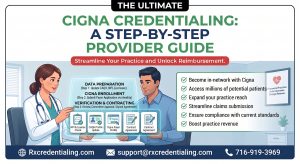
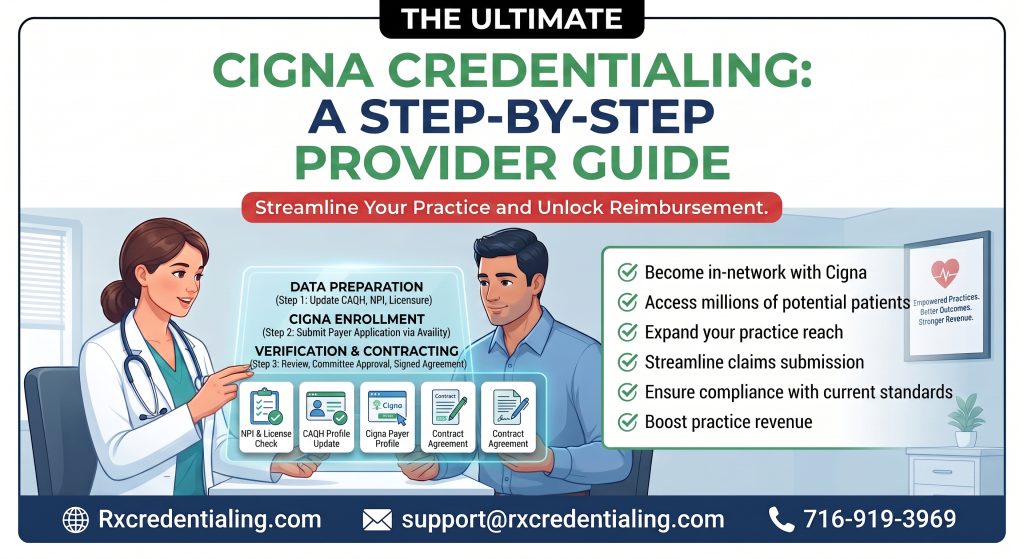
Cigna is one of the largest commercial payers in the country — but credentialing with them requires navigating network availability checks, CAQH setup, and a 90–120 day review window. This guide walks you through every step so nothing gets missed.
⚡ Quick Answer
To credential with Cigna, you must first confirm the network is open in your specialty and area, then complete your CAQH ProView profile, submit a Cigna network participation request through Availity, and wait 90–120 days for review and contracting. You cannot see Cigna patients as an in-network provider or bill Cigna at participating rates until credentialing is complete and a contract is executed.
Bottom line: Cigna credentialing is a multi-stage process. The two things that delay it most are an incomplete CAQH profile and applying to a closed network without checking first.
Common Questions About Cigna Credentialing
How long does Cigna credentialing take?
Cigna credentialing typically takes 90 to 120 days from complete application submission. It can run longer if your CAQH profile is incomplete, the network is at capacity in your specialty, or Cigna requests additional documentation. Submitting a fully complete, verified application from the start is the single biggest factor in keeping that timeline tight.
Does Cigna use CAQH for credentialing?
Yes. Cigna uses CAQH ProView as its primary credentialing data source. Your profile must be complete, attested, and current before Cigna will process your application. An expired CAQH attestation (they expire every 120 days) is one of the most common reasons Cigna applications stall mid-review.
Is Cigna’s provider network open to new providers?
It depends on your specialty and geographic market. Cigna closes networks in areas where it determines sufficient provider coverage already exists. You must submit a network participation request first and receive confirmation that the network is open before submitting a full credentialing application. Applying to a closed network will result in rejection without starting the credentialing process.
What documents does Cigna require for credentialing?
Cigna requires: an active state medical license, DEA certificate (if applicable), Type 1 NPI, current malpractice insurance certificate with limits meeting Cigna’s minimums, a completed and attested CAQH ProView profile, a CV or work history for the past 5 years, board certification documentation (if applicable), and proof of hospital privileges if you are hospital-based.
Can I bill Cigna while credentialing is pending?
No. You cannot bill Cigna at in-network rates until credentialing is complete and a participating provider contract is signed and effective. Submitting claims before your effective date results in out-of-network payment or denial. Cigna’s retroactive billing policy is limited — do not assume retroactivity applies without confirming directly with Cigna’s provider relations team.
Cigna Credentialing: Step-by-Step Process
The Cigna credentialing process has six distinct stages. Completing each one correctly — before moving to the next — is the difference between a 90-day approval and a 6-month delay.
Check Network Availability
Before anything else, verify that Cigna’s network is open in your specialty and service area. Log into Availity or call Cigna Provider Services to request a network availability review. If the network is closed, your application will be rejected at intake. This check takes 1–3 business days and should be your first step — not an afterthought.
Complete and Attest Your CAQH Profile
Cigna pulls your credentialing data directly from CAQH ProView. Your profile must be 100% complete — no blank sections, no expired documents, and fully attested within the last 120 days. Upload your current malpractice certificate, license, DEA certificate, and CV. Any gap in your profile becomes a gap in your Cigna application.
Submit a Network Participation Request
Once you confirm the network is open, submit a formal participation request through Availity or Cigna’s provider enrollment line. This initiates the application and triggers Cigna to send you (or your credentialing company) the provider enrollment packet. Keep a record of your submission date — it is your official application start date for timeline tracking.
Complete the Provider Enrollment Packet
Cigna will send a provider-specific enrollment packet that supplements your CAQH data. Fill it out completely and return it with all required supporting documents within the deadline Cigna specifies — typically 30 days. Incomplete packets are returned and restart your timeline. Do not leave any fields blank; write “N/A” where a question doesn’t apply rather than skipping it.
Primary Source Verification (PSV) Review
Cigna (or its credentialing vendor) verifies your credentials against primary sources: the state medical board, DEA database, NPDB (National Practitioner Data Bank), malpractice history, and any prior hospital privileges. This stage is non-negotiable and cannot be accelerated from your end. Keep your CAQH profile attested during this period — an expired attestation during PSV stops the clock.
Contracting and Effective Date
After PSV is complete, Cigna’s credentialing committee approves your file and moves it to contracting. You will receive a participating provider agreement to sign. Your effective date is the date Cigna establishes in your contract — not the date you submitted your application, and not the date you signed. Do not see patients as in-network until Cigna confirms your effective date in writing.
Documents Required for Cigna Credentialing
Gather these before submitting. Missing even one delays your entire application.
Cigna Commercial vs. Cigna Medicare Advantage: What’s Different
Cigna operates two separate networks that require separate enrollment:
- Cigna Commercial (employer-sponsored plans): Standard network participation request through Availity. Credentialing and contracting handled by Cigna’s commercial provider relations team.
- Cigna Medicare Advantage (CignaHealthSpring): Requires active Medicare PECOS enrollment first. You must be enrolled and active in Medicare before Cigna will credential you for its MA plans. This is a separate credentialing track — being contracted for Cigna commercial does not automatically enroll you in their MA product.
If you want to be in-network for both, start both processes simultaneously rather than sequentially. The PECOS enrollment for Medicare Advantage alone can take 60–90 days, meaning you could wait over 6 months if you do them one after the other.
⚠️ Important: Do not assume that your commercial Cigna contract covers Medicare Advantage patients. They are separate networks. Billing a MA patient under a commercial contract — or vice versa — constitutes a billing error and can trigger recoupment.
Cigna Credentialing Mistakes That Delay Approval
- Skipping the network availability check: Applying to a closed network restarts the process. Always confirm availability before submitting any paperwork.
- Expired CAQH attestation: CAQH attestations expire every 120 days. If yours lapses mid-review, Cigna’s verification is paused until you re-attest. Set a calendar reminder.
- Malpractice coverage gaps: If your certificate of insurance shows any lapse in coverage — even a single day between policies — Cigna will flag it and may require a letter of explanation from your insurer. Avoid switching insurers during the credentialing process.
- Unexplained CV gaps: Employment gaps of more than 30 days that are not explained in your CV trigger PSV delays. Account for parental leave, training, or periods of non-practice with brief notes.
- Wrong taxonomy code in NPPES: Your CAQH taxonomy must match your NPPES taxonomy exactly. A mismatch causes Cigna’s system to reject the application at data intake before a human reviewer ever sees it.
- No follow-up after submission: Cigna does not proactively notify you of missing information in all cases. Follow up every 30 days via Availity or Cigna Provider Services to confirm your application status and catch any outstanding items before they cause a silent delay.
How RxCredentialing Handles Cigna Enrollment for You
The most time-consuming parts of Cigna credentialing — network availability confirmation, CAQH auditing, packet completion, and PSV tracking — are the parts that cause 90% of delays when providers handle them internally. Our team handles every step:
- Network availability check before any paperwork is submitted
- Full CAQH profile audit and attestation management
- Cigna enrollment packet completion and submission
- 30-day follow-up cycle with Cigna Provider Relations throughout PSV
- Contract review and effective date tracking
- Parallel enrollment if you need both commercial and Medicare Advantage coverage
We also handle Cigna medical billing — so once you’re credentialed, your claims go out clean the first time. No hand-off, no gap in the process.
Free Credentialing With Medical Billing From $499 / month
Join the fastest growing network of healthcare providers who have streamlined their revenue cycle and completely eliminated administrative headaches.
Written by the Rx Team
RxCredentialing’s content team includes certified revenue cycle specialists with direct experience in Cigna, Aetna, BCBS, and Medicare credentialing across all 50 states. We manage hundreds of active payer credentialing files monthly.