Insurance companies require prior authorization for roughly 1 in 4 procedures — and getting it wrong costs providers money, time, and sometimes patient outcomes. Here’s exactly how the process works and how to stop losing approvals before the claim even starts.
⚡ Quick Answer
Prior authorization (PA) is pre-approval required by an insurer before certain treatments, medications, or procedures will be covered. The provider submits clinical documentation; the payer reviews it against medical necessity criteria and either approves, denies, or requests more information. Without an approved PA, the claim is typically denied — even if the service itself was medically appropriate.
Frequently Asked Questions About Prior Authorization
What is prior authorization in healthcare?
Prior authorization is a payer requirement that a provider obtain approval before delivering a specific service, medication, or procedure. The provider submits clinical documentation — diagnosis codes, treatment rationale, trial-and-failure records — and the payer’s medical reviewer determines whether the service meets their medical necessity criteria. Only after approval does the payer agree to cover the cost. Without it, the claim is denied regardless of whether care was clinically appropriate.
How long does prior authorization take?
It varies by payer and urgency. Standard commercial PA requests typically take 1–14 business days. Under the 2026 CMS Final Rule, Medicare Advantage and Medicaid managed care plans must respond to standard PA requests within 7 calendar days and to expedited (urgent) requests within 72 hours. Traditional Medicare requires PA for a narrower set of services and typically processes requests faster, but DMEPOS and select outpatient services can still take 5–10 days.
What happens if prior authorization is denied?
A denial is not final — it is a starting point for appeal. Your first step is reviewing the denial reason code on the Explanation of Benefits (EOB). Most plans allow a first-level internal appeal within 30–60 days of the denial. You can submit additional clinical documentation, request a peer-to-peer review (a call between your physician and the payer’s medical director), or both. If the internal appeal fails, you have the right to an external Independent Medical Review (IMR) in most states. For Medicare Advantage, there are five formal appeal levels culminating in Federal District Court.
Is prior authorization required for Medicare?
Traditional Medicare (Parts A and B) uses PA for a limited list of services: selected outpatient hospital services, certain DMEPOS items, and a few high-cost drugs. Medicare Advantage plans (Part C) may impose PA broadly — but under the 2026 CMS rules, they cannot require PA for services that were previously approved for a patient still enrolled in the same plan, and they must process requests within the mandated timeframes. Medicaid PA requirements vary by state.
Does credentialing affect prior authorization approvals?
Yes — credentialing is a prerequisite, not just a billing formality. A provider who has not completed insurance credentialing with a payer has no contracted rate on file. Many payers will not process PA requests from non-contracted providers, or they will approve the PA but pay at out-of-network rates — leaving the patient with a large balance. Completing credentialing before rendering services is essential for PA requests to flow through without a payer-level block.
How Prior Authorization Works: Step by Step
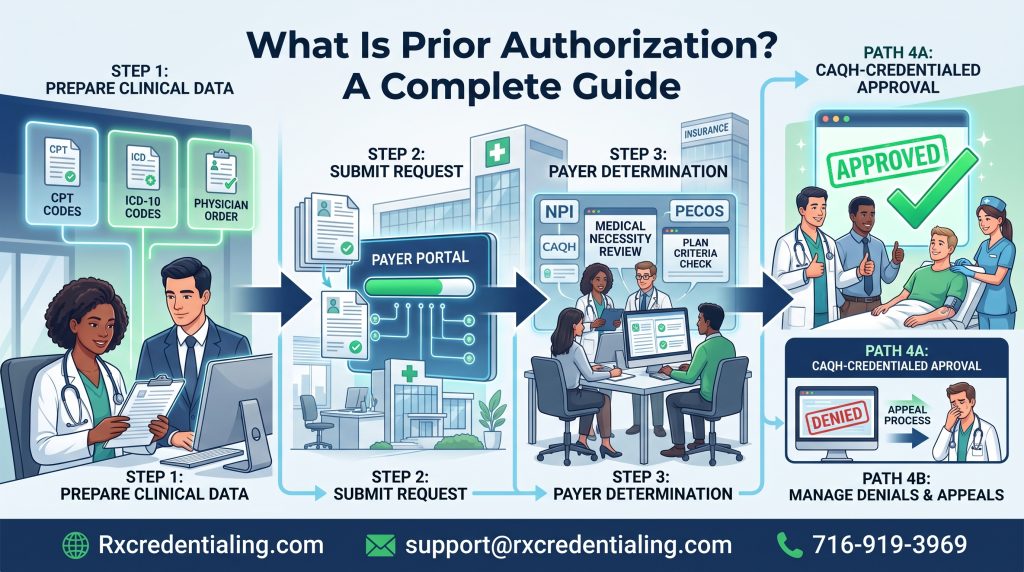
The PA process follows a predictable path, but each payer has their own forms, portals, and timeframes. Understanding each step lets you build a workflow that catches issues before they cause denials.
Verify PA Requirement Before the Appointment
Check the patient’s benefits and your payer contract to confirm whether the planned service requires PA. Most payers publish PA lists online; use the insurer’s provider portal or call the provider services line. Checking upfront prevents last-minute denials after care is already rendered.
Gather Clinical Documentation
Collect the items payers consistently request: the treating physician’s order, relevant diagnosis codes (ICD-10), the procedure code (CPT), recent office notes, lab results, imaging reports, and any prior treatment history. For specialty services, payers often require documentation of “step therapy” — proof the patient tried and failed a lower-cost alternative first.
Submit the PA Request
Submit through the payer’s preferred channel: provider portal (fastest), fax, or phone. Include the patient’s member ID, the provider’s NPI and Tax ID, the requested CPT/HCPCS code, and all supporting documentation. Incomplete submissions are the single biggest driver of avoidable delays.
Track the Request and Follow Up
Log the PA reference number and submission date immediately. If you haven’t received a decision by two-thirds of the payer’s stated turnaround time, call to confirm receipt and check status. Don’t wait for the deadline — payers won’t automatically notify you of processing delays.
Receive the Determination
Payers issue an approval, denial, or request for additional information (RFAI). Approvals include an authorization number — record it and attach it to the claim. An RFAI must be responded to quickly; most payers close the request if you don’t respond within their window (typically 10–15 business days). A denial triggers the appeal process.
Bill With the Authorization Number
Include the authorization number on the claim in the appropriate field (Box 23 on the CMS-1500). Failure to reference it — even for an approved PA — is a common reason claims are paid at a lower rate or denied on submission. Verify that the authorization covers the exact CPT code, date of service, and treating provider NPI billed.
Prior Authorization Timelines by Payer Type (2026)
| Payer Type | Standard PA | Expedited / Urgent PA | Retroactive PA |
|---|---|---|---|
| Medicare Advantage | 7 calendar days | 72 hours | Generally not allowed; very rare exceptions |
| Medicaid Managed Care | 7 calendar days | 72 hours | State-dependent; 24–72 hours for emergencies |
| Commercial (BCBS, Aetna, etc.) | 3–14 business days | 1–3 business days | Allowed within 48–72 hours in true emergencies |
| UnitedHealthcare | Up to 10 business days | 72 hours | Limited; requires clinical justification |
| Traditional Medicare (Parts A/B) | Varies by MAC; typically 5–10 days | 2–3 business days | Available in true emergency admissions |
Most Common Reasons Prior Authorization Is Denied
Understanding why PAs are denied is the fastest way to stop them from being denied. The majority of first-time denials are administrative — not clinical — meaning they’re preventable.
Incomplete Documentation
Missing office notes, outdated lab results, or absent step-therapy records are the top driver. Payers don’t request missing items — they simply deny the request.
Incorrect CPT / Diagnosis Code
A code mismatch between the PA request and the submitted claim automatically triggers denial. Verify that ICD-10 and CPT codes on the PA match the claim exactly.
PA Requested After Service
Retroactive PAs are rarely granted except in emergencies. Scheduling a service before confirming PA is the most expensive administrative mistake a practice can make.
Authorization Expired
Most PAs are valid for 30–90 days. Rendering service on day 91 on a 90-day auth means the claim will be denied — regardless of prior approval.
Non-Covered Service or Benefit Limit
Certain services are excluded from the patient’s plan entirely. A PA denial citing “non-covered benefit” requires a benefits review — not just a clinical appeal.
Provider Not Credentialed or Out-of-Network
A PA granted to a credentialed provider does not transfer if a different provider renders the service. Each rendering provider must be individually contracted with the payer.
7 Ways to Reduce Prior Authorization Denials
- Build a PA requirement checklist by payer. Each insurer has different PA triggers. Maintain a living document updated quarterly so your front desk can identify PA requirements before scheduling.
- Submit documentation packages, not just the form. Include everything — office notes, imaging, labs, specialist letters — with the initial submission. Never make the reviewer ask twice.
- Use the payer’s clinical criteria language. Payers review submissions against published criteria (InterQual, MCG, or proprietary). Mirror that language in your clinical notes. “Medically necessary” written in payer-matching language is reviewed differently than vague narrative.
- Request peer-to-peer reviews early. After a first denial, requesting a peer-to-peer (your physician calls the payer’s medical director) overturns the decision up to 60–70% of the time — but this option expires. Use it before filing a formal appeal.
- Track authorization expiration dates proactively. Set calendar reminders 2 weeks before auth expiry. Renewing in advance is far faster than pursuing retroactive authorization after the fact.
- Handle denial management as a dedicated workflow. Don’t let denials age in your AR. A denied PA that isn’t appealed within the filing window becomes an unrecoverable loss.
- Complete credentialing before scheduling. Confirm your providers are contracted and active with each relevant payer before accepting patients on that plan. A PA cannot save a claim from a non-credentialed provider block.
2026 CMS Prior Authorization Final Rule — What Changed
Effective January 2026, CMS finalized new PA rules for Medicare Advantage, Medicaid managed care, and CHIP plans. Key changes: payers must respond within 72 hours for urgent requests and 7 calendar days for standard requests. Payers must also provide specific clinical reasoning when denying PA — vague denials are no longer permitted. Additionally, insurers must implement electronic PA (ePA) APIs, reducing fax-based submission. Providers credentialed and active with these plans will benefit most from the faster decision timelines.
Why Credentialing and Prior Authorization Are Inseparable
Most practices treat credentialing and prior authorization as separate administrative functions. They aren’t — and the disconnect creates silent revenue loss that compounds every month.
Here’s the problem: a prior authorization is issued to a specific provider at a specific contracted facility. If the rendering provider is credentialed with Payer A but not Payer B, a PA from Payer B has no effect — the claim will be denied at the adjudication stage. This is particularly common in:
- Group practices where one physician is credentialed but a covering provider is not
- Newly hired providers who begin seeing patients before credentialing is complete
- Mental health practices where multiple therapists bill under one group NPI but individual credentialing is required
- Anesthesia groups with high provider turnover where lapse periods create coverage gaps
The practical implication: your PA approval rate is a downstream indicator of your credentialing health. Practices with active, current credentialing across all rendering providers have fewer PA blocks, faster adjudication, and lower denial rates on submission.
Payers like UnitedHealthcare and Aetna have moved to automated credentialing verification at the PA stage — meaning a lapsed credential can block a PA submission in real time, before a human reviewer ever sees the case.
Credentialing Gap = Retroactive Denial Risk
If a provider’s credentialing lapses mid-treatment-course, any PA previously approved may be retroactively voided by the payer — leaving you unable to bill for services already rendered. This is most common when CAQH attestation (required every 120 days) is not renewed on time. Monitor attestation expiry dates as carefully as authorization expiry dates.
Free Credentialing With Medical Billing From $499 / month
Join the fastest growing network of healthcare providers who have streamlined their revenue cycle and completely eliminated administrative headaches.
Rx Credentialing Team
Specialized in provider enrollment, payer credentialing, and revenue cycle management for healthcare practices across the United States.