
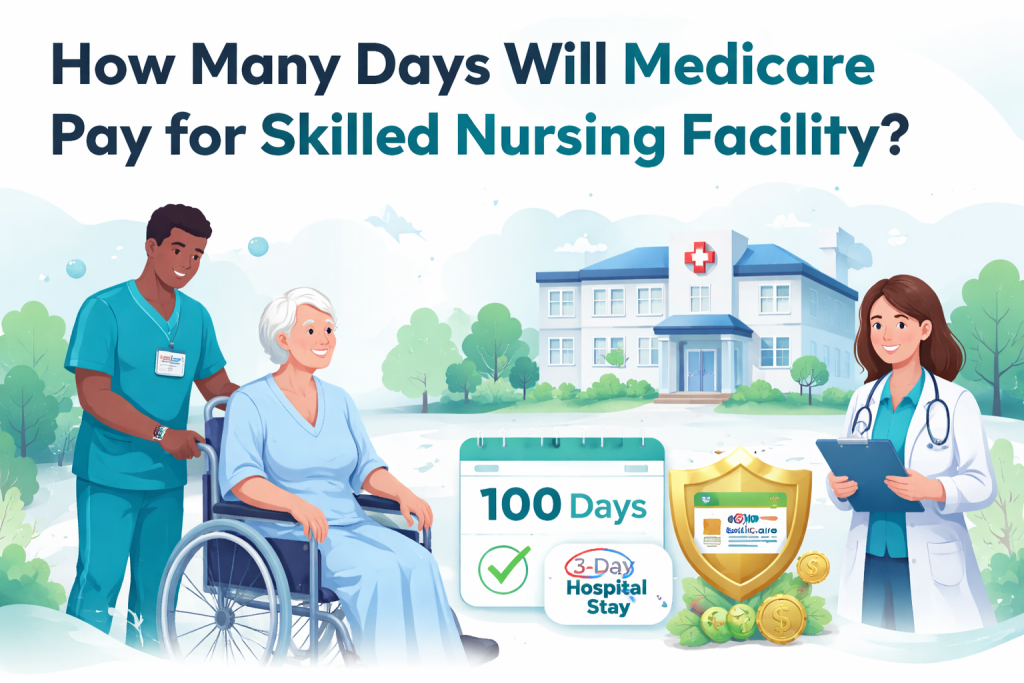
If you’re planning a rehab stay after a hospitalization, the “100 days” rule can be confusing. This guide breaks down exactly how many days Medicare pays for a skilled nursing facility (SNF), what you may owe, when the clock resets, and why coverage can end early.
Quick answer: Under Original Medicare Part A, Medicare can cover up to 100 days of SNF care per benefit period—but only if you meet specific eligibility rules (including a qualifying inpatient stay and medical necessity).
Educational content only (not legal advice). Medicare rules and cost-sharing can change; confirm details with Medicare, your plan, and your facility.
How many days will Medicare pay for a skilled nursing facility?
Under Original Medicare, Medicare Part A may pay for up to 100 days of care in a Medicare-certified skilled nursing facility (SNF) during each benefit period, as long as you meet all coverage requirements.
Important: “Up to 100 days” does not mean everyone automatically receives 100 covered days. Coverage can stop earlier if you no longer need skilled care or if eligibility rules aren’t met.
Medicare’s SNF benefit is designed for short-term rehab or skilled nursing after a qualifying inpatient hospital stay. It is not long-term nursing home coverage for purely custodial care.
External references (official + trusted)
Official overview: Medicare.gov — Skilled nursing facility care. Plain-language consumer guide: Medicare Interactive — SNF coverage.
What “skilled nursing facility” means (and what it doesn’t)
Medicare SNF (covered when eligible)
- Skilled nursing (wound care, IV meds, injections by licensed staff)
- Skilled therapy (PT/OT/ST) ordered by a provider
- Care that’s medically necessary and requires professional skill
Custodial care (usually not covered by Medicare)
- Long-term assistance with ADLs only
- Room/board for long-term placement
- Supervision when skilled services aren’t needed
Medicare SNF costs: days 1–20 vs days 21–100
| Covered SNF days (per benefit period) | Typical cost responsibility | What to confirm |
|---|---|---|
| Days 1–20 | Medicare Part A pays (often $0 coinsurance if eligible) | All eligibility criteria met and SNF is Medicare-certified |
| Days 21–100 | You owe a daily coinsurance unless secondary coverage pays it | Current year coinsurance + Medigap/secondary coverage details |
| After day 100 | Medicare Part A stops paying for SNF in that benefit period | Next payer (Medicaid/LTC insurance/VA/private pay) and discharge plan |
Caregiver script: “Can you confirm which SNF day number we’re on and what costs begin on day 21?”
Eligibility: when Medicare will actually pay for SNF care
The “3-day rule” (qualifying inpatient stay)
In general, Medicare-covered SNF services require a medically necessary 3-consecutive-day inpatient hospital stay (discharge day does not count). Observation status is usually outpatient and typically does not count.
Big pitfall: “Observation” can look like an inpatient stay to families—but it can block SNF coverage under the standard rule.
Skilled need (medical necessity)
Medicare coverage generally continues only while you need skilled nursing and/or skilled therapy services that require licensed professionals and are reasonable and necessary.
Often supports “skilled”
- Post-surgical rehab with measurable therapy goals
- Complex wound care
- IV medications or skilled monitoring
Often not “skilled” by itself
- Long-term help with bathing/dressing only
- Supervision without skilled services
- Maintenance care after goals are met
Benefit period explained: when the “100 days” clock resets
The 100-day limit is tied to a benefit period. Generally, a benefit period ends after you’ve been out of a hospital or SNF for 60 consecutive days (or, if you remain in a SNF, when you haven’t needed skilled care there for 60 days).
Why SNF coverage can end before day 100
Medicare may stop paying before day 100 if you no longer meet skilled medical necessity criteria—even if you still need help at a nursing facility.
- Skilled need ends (goals met / no longer requires skilled services)
- Documentation gaps don’t support skilled care continuation
- Eligibility issue (inpatient vs observation / 3-day rule problem)
- Medicare Advantage rules (authorization/network policies)
What happens after 100 days in a skilled nursing facility?
After day 100 in the same benefit period, Medicare Part A generally stops paying for SNF. Then costs may shift to Medicaid (if eligible), long-term care insurance, VA benefits, or private pay.
Appeals: what to do if coverage is denied or ending
- Ask for the reason in writing (not skilled vs eligibility vs plan policy).
- Request documentation (hospital status, discharge summary, therapy/nursing notes).
- Ask about expedited appeal options if discharge is imminent.
- Parallel-plan (secondary coverage, Medicaid screening, discharge options).
Need help with Medicare enrollment, credentialing, or billing workflow?
RxCredentialing helps provider groups and healthcare organizations streamline payer enrollment and reduce denial risk.
FAQ
Is it always 100 days of SNF coverage?
No. Medicare can cover up to 100 days per benefit period, but it can stop earlier if skilled care is no longer medically necessary or eligibility rules weren’t met.
Do observation days count toward the 3-day rule?
Typically no. Observation is usually outpatient status even if you stay overnight, and it generally does not count toward the inpatient 3-day requirement.
Does the 100-day limit reset every calendar year?
No. It resets by benefit period rules (often after 60 consecutive days out of hospital/SNF or without skilled care).
How does Medicare Advantage change SNF coverage?
Medicare Advantage plans can require prior authorization and may have networks and different copays. Always confirm with the plan before admission when possible.
External references used: Medicare.gov and Medicare Interactive.