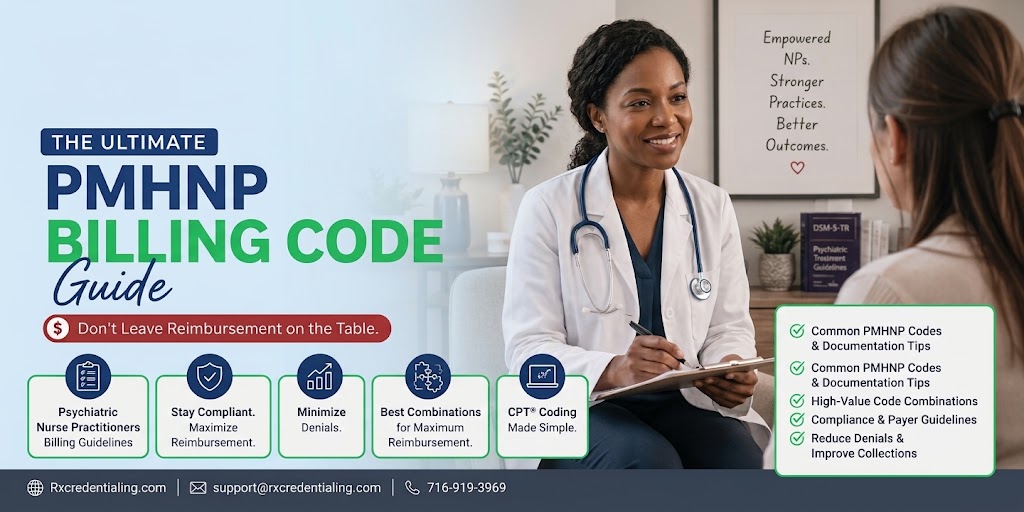
Most PMHNPs who go independent never trained for billing — nursing school teaches you to treat the patient, not to translate that visit into a CPT code that pays fairly for the work. That gap is where revenue quietly disappears: a visit gets under-coded out of caution, an add-on gets left off the claim, or a payer downcodes something that should never have been questioned.
Before you use this as your coding bible: Medicare rates are public and locality-adjusted — figures below can shift 10–25% by region. Confirm your exact rate on the CMS Physician Fee Schedule Look-Up Tool.
Frequently Asked Questions
How does visit complexity decide my E/M code?
Since 2021, codes are picked by medical decision-making (MDM) or total time spent. For example, a stable patient on an unchanged regimen is low complexity (99213), while a dose change or new symptom is moderate (99214). A first psych evaluation is very often moderate complexity by default because an undiagnosed new problem qualifies on its own.
How do I bill for long-acting injectables in my practice?
Two separate parts are billed: the drug itself (HCPCS J-code, usually billed by the pharmacy that supplies it) and the administration in your office (96372). You must use Modifier 25 on your E/M code (e.g., 99214-25) so Medicare’s NCCI edits don’t fold the injection payment into the visit.
What is the NP 85% Rule and incident-to billing?
When an NP bills Medicare directly under their own NPI, reimbursement is 85% of the physician fee schedule. “Incident-to” pays 100% but requires strict direct physician supervision, which is highly difficult for independent PMHNP practices to meet. Most independent NPs bill directly at 85%.
Direct NP Rate
The standard Medicare reimbursement rate for an NP billing directly under their own NPI.
Key Code Combos
Just four specific CPT code combinations account for the vast majority of PMHNP daily billing.
Highest Volume
The standard moderate complexity follow-up code, often paired with therapy add-ons.
How Visit Complexity Decides Your Code
Since 2021, office visit codes are picked by medical decision-making (MDM) — how complex the clinical decisions were — or by total time spent. For established patients, that usually comes down to: a stable patient on an unchanged regimen is low complexity, a dose change or new symptom is moderate, and multiple changes or significant risk is high.
For new patients, it’s slightly different — a first psych evaluation is very often moderate complexity by default, because an undiagnosed new problem with uncertain prognosis qualifies on its own, whether or not the patient has any chronic history. That’s the whole judgment call — the code library below shows exactly where each level lands. Need help managing this systematically? Learn more about medical billing services for small practices.
New Patient Visits
The first visit with a new patient — medical E/M and/or diagnostic evaluation.
| CPT Code | Est. Rate | Description & Complexity | Time / Rules |
|---|---|---|---|
| 99203 | ~$100 | New Patient E/M — Low Complexity Straightforward new-patient medical visit. One stable, known condition or a simple acute issue. Minimal treatment decisions. |
30–44 min |
| 99204 | ~$150 | New Patient E/M — Moderate Complexity The most common new-patient psych visit. New, undiagnosed problem with uncertain prognosis or an existing condition that’s worsening. |
45–59 min |
| 99205 | ~$192 | New Patient E/M — High Complexity Presentation with significant risk. Condition posing a threat to safety or function (e.g., active suicidality, psychosis). |
60–74 min |
| 90791 | ~$150 | Psychiatric Diagnostic Evaluation Initial intake, no medical services performed. History gathering, mental status exam. No prescribing or med review that visit. |
Diagnostic / Intake |
| 90792 | ~$172 | Psychiatric Diagnostic Eval + Medical Same as 90791, plus a prescribing decision. Medication review or new prescription. Labs ordered. Use instead of 90791 when meds are addressed. |
Diagnostic + Meds |
Med Management Only — Established Patient
Follow-up visits with no separately billed therapy component.
| CPT Code | Est. Rate | Description & Complexity | Time Range |
|---|---|---|---|
| 99213 | ~$81 | Low Complexity Med check, mild symptom change. Stable diagnosis, no med changes, routine refill or monitoring. |
20–29 min |
| 99214 | ~$115 | Moderate Complexity Dose adjustment or new symptom. Medication change, new or worsening symptom. |
30–39 min |
| 99215 | ~$163 | High Complexity Severe symptoms or a safety risk. Condition posing a threat to safety or function requiring urgent action. |
40–54 min |
Therapy Add-Ons — Billed With E/M, Same Visit
Append to any 99202–99215 code when you also provide psychotherapy that visit.
| CPT Code | Est. Rate | Description & Pairing Rules | Time Range |
|---|---|---|---|
| 90833 | ~$69 | Psychotherapy Add-On, 30 min Requires separated E/M + therapy documentation. Pairs with: 99202–99215. |
16–37 min |
| 90836 | ~$88 | Psychotherapy Add-On, 45 min Same documentation rule as 90833. Pairs with: 99202–99215. |
38–52 min |
| 90838 | ~$107 | Psychotherapy Add-On, 60 min Same documentation rule as 90833. Pairs with: 99202–99215. |
53+ min |
| 90785 | ~$4 | Interactive Complexity Add-On Complex communication factors present (caregiver relays history, language barrier, mandated report). Pairs with psychotherapy codes only. |
Add-On |
Extended, Family, and Crisis Services
Rates below are estimated from published state and payer fee schedules — confirm your exact Medicare rate before billing.
| CPT Code | Est. Rate | Description & Pairing Rules |
|---|---|---|
| 90832/34/37 | Varies | Standalone Therapy (30/45/60 min) Use when the visit is purely psychotherapy — no medication management performed. |
| 99417 | ~$45 | Prolonged Service, Each Additional 15 min Time beyond the max range of primary code. Pairs with: 99205, 99215. |
| 90846 / 90847 | ~$88-94 | Family Psychotherapy (w/ or w/o Patient) Family session, 50 minutes. |
| 90839 | ~$112 | Crisis Psychotherapy, First 60 min Face-to-face crisis intervention (immediate risk to patient/others). |
| 90840 | ~$57 | Crisis Psychotherapy, Additional 30 min Add-on to 90839 only. Cannot be billed with 90791/92 or 90832-38. |
The 4 Combos That Cover Most of Your Billing
If nothing else clicks from this article, know these four. They’re the most commonly billed code combinations in a psych NP practice. Commercial behavioral health reimbursement typically runs 90%–140% of Medicare depending on payer, region, and your payer contract negotiation. Treat the commercial column as a planning range, not a quote.
| Combo Type | Codes Billed | Medicare (NP) | Commercial Est. |
|---|---|---|---|
| New Patient Initial eval (moderate) + 16–37 min therapy |
99204 + 90833 | ~$219 | $197 – $307 |
| Standard Follow-Up Med management + brief therapy |
99214 + 90833 | ~$184 | $165 – $257 |
| Interactive Complexity Standard follow-up + communication barrier |
99214 + 90833 + 90785 | ~$188 | $169 – $264 |
| Injectable Administered Follow-up + injection (Requires Mod 25) |
99214-25 + 90833 + 96372 | ~$206 | $185 – $292 |
Free Credentialing With Medical Billing From $499 / month
Join the fastest growing network of healthcare providers who have streamlined their medical billing operations and eliminated administrative headaches.
Where Revenue Actually Leaks
Four patterns account for most of the money psych NP practices lose on otherwise-correct visits. Proper denial management relies on avoiding these altogether.
Defaulting to 99213 out of habit
If your documentation supports moderate MDM (like adjusting a medication dosage or managing a new symptom), billing a 99214 isn’t upcoding — it’s accurate coding. Chronically billing 99213 out of fear leaves thousands of dollars on the table.
Blended E/M and therapy notes
Without a clear, separated line of documentation between your medical decision-making and your psychotherapy interventions, payers will strip the add-on code entirely during an audit.
Missing Modifier 25 on injection days
Without Modifier 25 on the E/M code, bundling edits automatically fold the injection administration (96372) into the E/M visit. You get paid for one service instead of two. See our Modifier 25 billing guide for the full mechanics.
Wrong telehealth modifier for the payer
Medicare, Medicaid, and commercial plans do not share the same rules. Some require Modifier 95, some want POS 10 (patient at home) vs POS 02 (patient elsewhere), and others have entirely separate audio-only logic. Mismatches here are a top cause for denials.
About the Author: RxCredentialing Expert Team
Our specialized Revenue Cycle Strategists have over 15 years of experience helping private practices, nurse practitioners, and behavioral health providers optimize clinical workflows, credentialing, and financial health.